
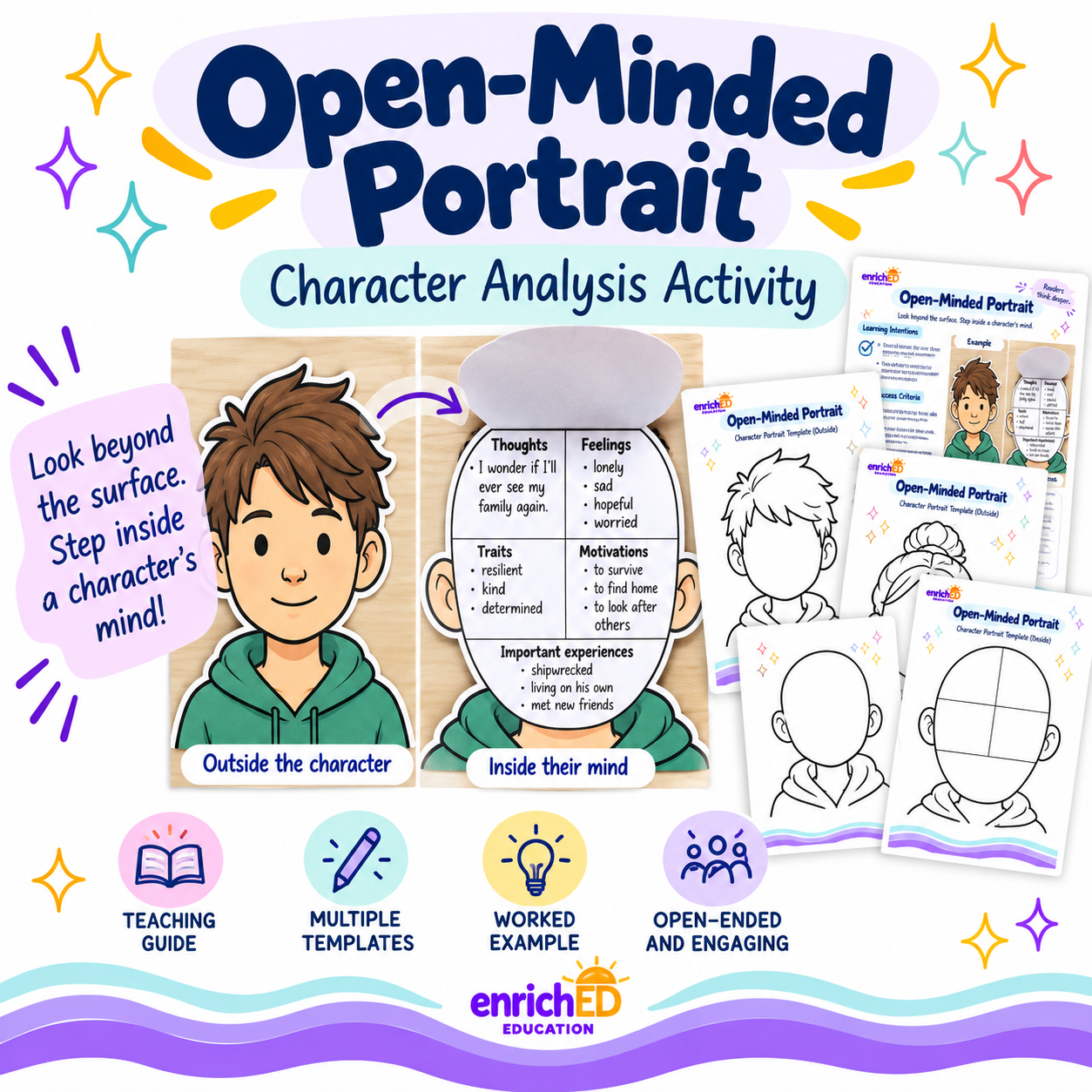
A creative, hands-on reading comprehension activity that encourages students to look beyond a character's appearance and explore what's happening inside their mind.
Students create an interactive lift-the-flap character portrait to investigate a character's thoughts, feelings, personality traits, motivations and important experiences.
By exploring both the outside and inside of a character, students develop a deeper understanding of characterisation and use evidence from the text to support their interpretations.
Students will:
identify and describe character traits
infer a character's thoughts and feelings
explore motivations and important experiences
distinguish between a character's appearance and inner world
support their ideas with evidence from the text
reflect on what makes a character unique
What's included:
Learning Intentions and Success Criteria
Step-by-step activity instructions
Completed worked example
Sentence starters and reflection prompts
Three character portrait templates
Inside-the-mind recording template
Interactive lift-the-flap activity
5-page printable PDF digital download.
Suitable for reading groups, literature studies, independent reading responses and whole-class comprehension activities.
Use with your own narrative texts – no specific book required.
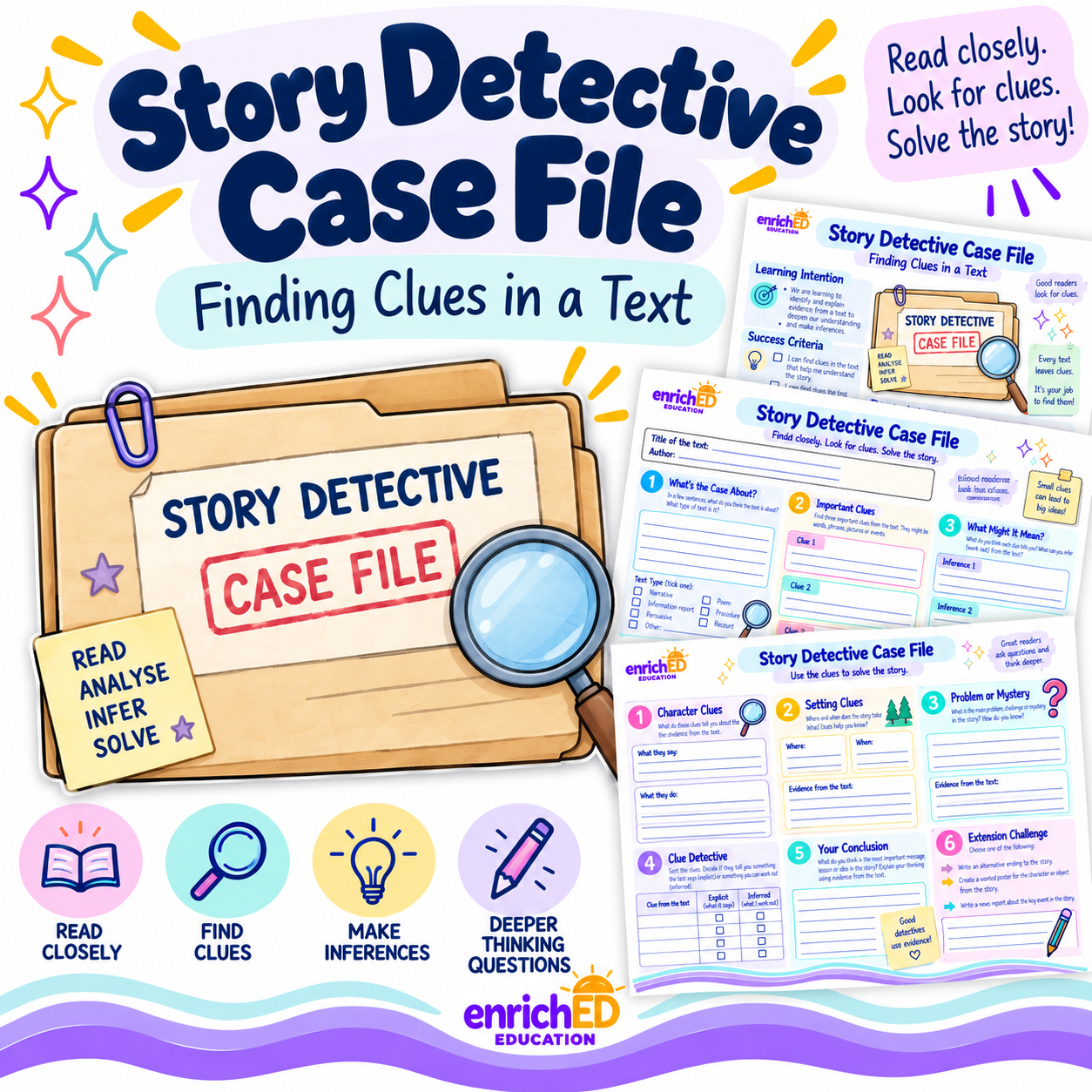
Turn your students into reading detectives with this engaging, evidence-based comprehension investigation!
Students become story detectives as they search for clues, make inferences and use evidence from the text to solve the story. Through a series of engaging activities, students learn to look beyond what is directly stated, investigate important details and draw conclusions supported by evidence.
This versatile resource includes open-ended detective case file templates that can be used with a range of texts, as well as an original reading passage, The Lost Wallet, with accompanying comprehension activities.
Students will:
Identify important clues and details within a text.
Distinguish between explicit information and inferred meaning.
Explore characters, settings, problems and key events.
Make inferences and support their thinking with textual evidence.
Investigate vocabulary and author choices.
Draw conclusions and explain their reasoning.
Make connections and consider different interpretations.
What's included:
Learning Intention and Success Criteria
Teaching instructions and detective vocabulary
Coloured Story Detective Case File recording templates
Black-and-white, printer-friendly comprehension templates
Original reading passage – The Lost Wallet
Literal and inferential comprehension questions
Vocabulary investigation and true-or-false activity
Character, setting and story analysis tasks
Evidence-based reasoning and reflection questions
Extension challenges to encourage deeper thinking
7-page printable PDF digital download.
Perfect for reading groups, guided reading, independent comprehension activities, literature studies and whole-class reading lessons.
Use the open-ended templates with your own texts or the included reading passage for a ready-to-use comprehension investigation.
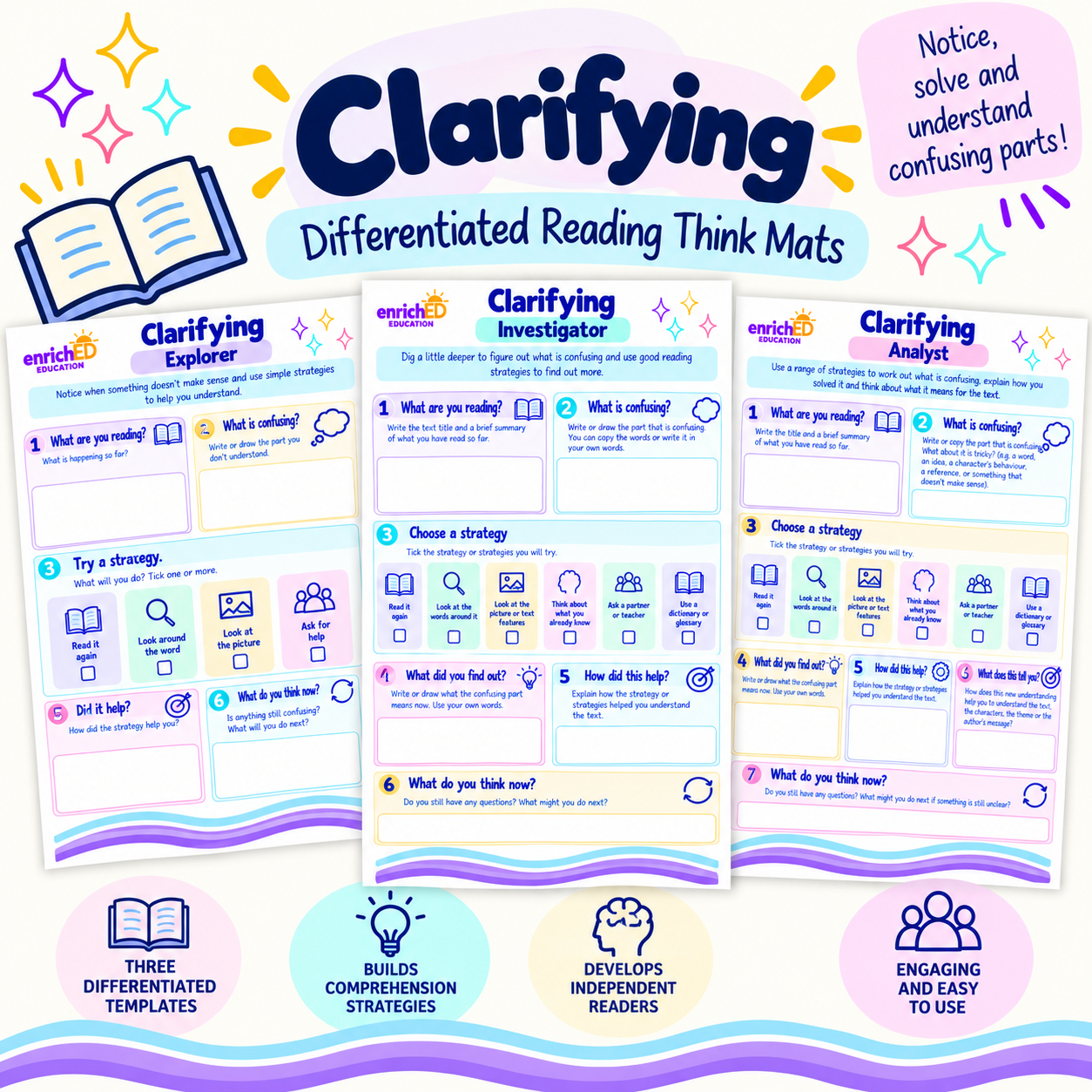
Help students become confident, independent readers with these three differentiated clarifying think mats.
Clarifying is an important reading comprehension strategy that helps students recognise when something doesn't make sense and take steps to improve their understanding.
These structured think mats encourage students to identify confusing words, ideas or sections of a text, select appropriate reading strategies and reflect on how their understanding has changed.
With three levels of support and challenge, teachers can choose the template that best meets each student's learning needs.
Students will:
Identify parts of a text they find confusing.
Select and apply strategies to clarify meaning.
Use context clues, rereading, visual information and other reading strategies.
Explain what they have discovered or understood.
Evaluate whether their chosen strategy was effective.
Reflect on their understanding and identify next steps.
What's included:
Explorer: A highly scaffolded six-step think mat with four simple clarifying strategies and opportunities to write or draw responses.
Investigator: A six-step think mat offering six reading strategies and encouraging students to explain how they resolved confusion.
Analyst: A more challenging seven-step think mat requiring students to examine why something is confusing, evaluate strategies and connect their new understanding to characters, themes or the author's message.
3-page printable PDF digital download.
Perfect for guided reading, reading groups, independent comprehension tasks, literature studies and formative assessment.
Suitable for use with a wide range of fiction and nonfiction texts – no specific book required.
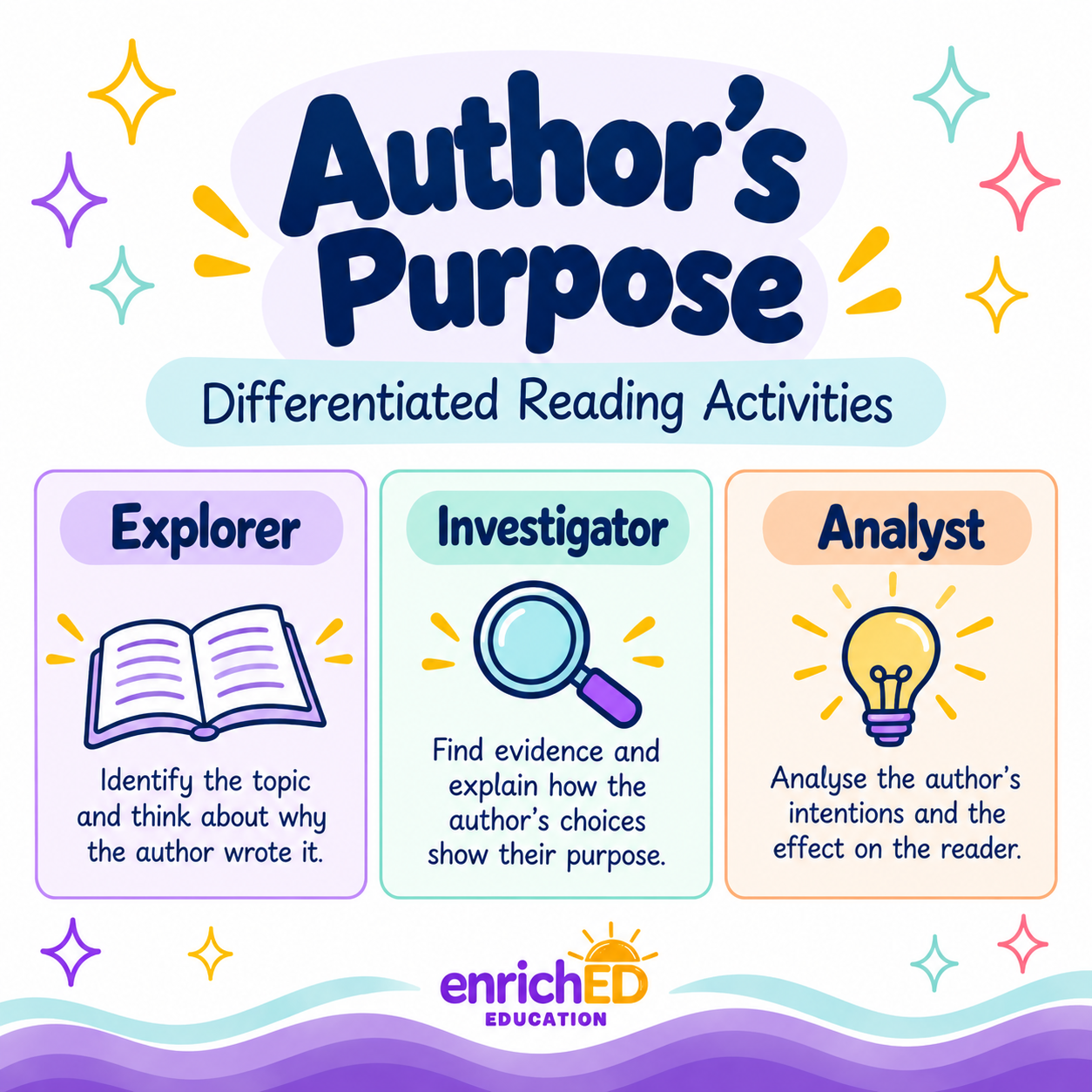
A flexible reading comprehension resource that helps students identify, explain and analyse an author's purpose using evidence from a text.
Students explore why an author has written a text, examine the choices they have made and consider how these choices influence the reader.
With three differentiated activity sheets, teachers can select the level of questioning that best suits their students. The open-ended format allows these activities to be used with a wide range of fiction and nonfiction texts.
Students will:
identify the main topic and purpose of a text
recognise clues that reveal the author's intention
support their thinking with evidence from the text
examine the author's language and text features
consider the intended audience
analyse how an author's choices influence the reader
What's included:
Author's Purpose Explorer – supported questions to identify purpose and recognise clues
Author's Purpose Investigator – deeper questioning about evidence, author choices and audience
Author's Purpose Analyst – extended analysis of intention, multiple purposes and reader impact
3-page printable PDF digital download.
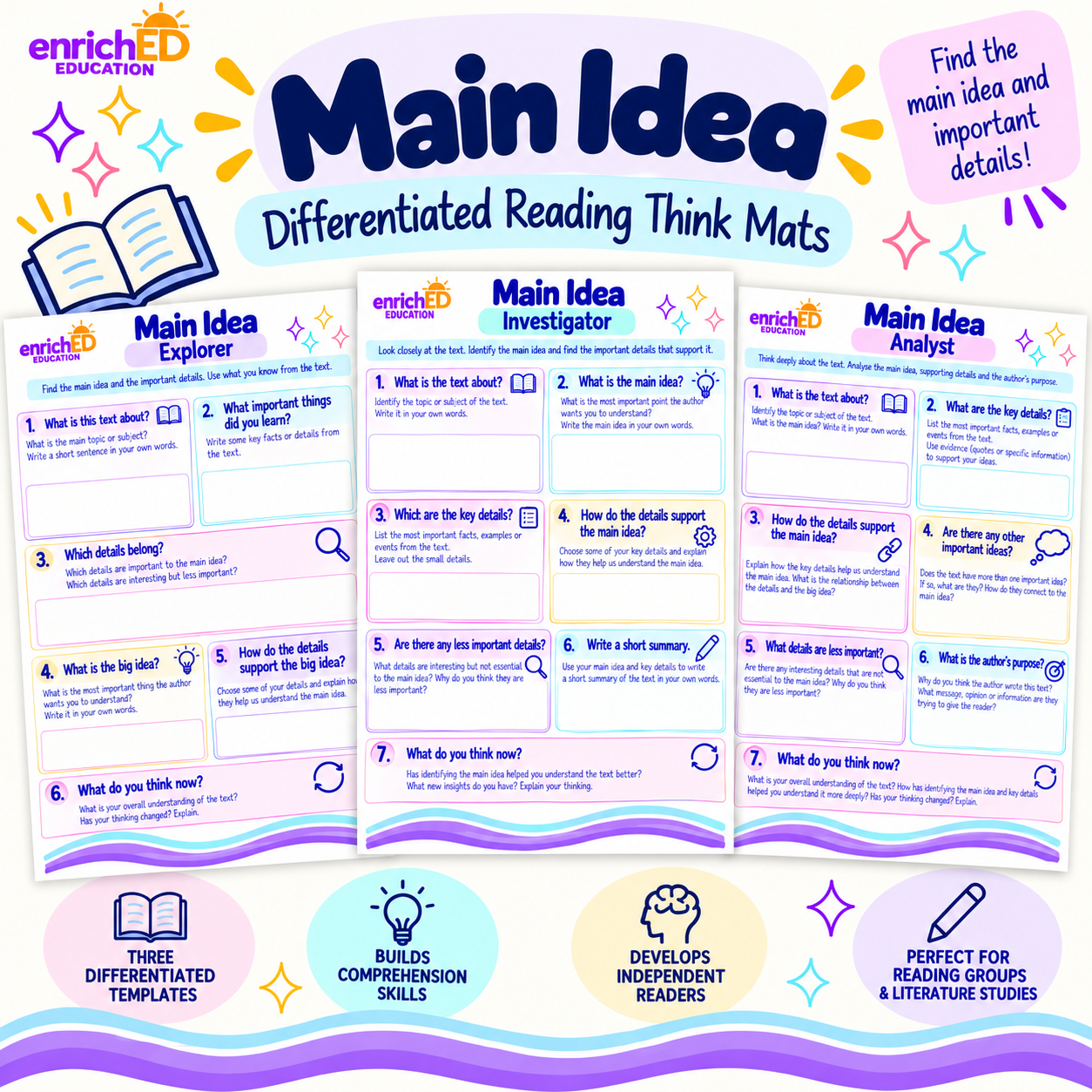
Help students identify the main idea, recognise important details and develop a deeper understanding of what they read with these three differentiated reading think mats.
Understanding the main idea is an essential reading comprehension skill. Students need to recognise what a text is mostly about, distinguish important information from less relevant details and explain how key details support the author's central message.
These structured think mats guide students through identifying the main idea, selecting supporting evidence and reflecting on their understanding.
With three levels of support and challenge, teachers can select the template that best suits each student's learning needs.
Students will:
Identify the topic and main idea of a text.
Recognise important facts, events and supporting details.
Distinguish key information from less important details.
Explain how supporting details develop the main idea.
Use textual evidence to justify their thinking.
Consider the author's purpose and message.
Reflect on their understanding of a text.
What's included:
Explorer: A scaffolded six-step think mat helping students identify the topic, recognise important details, determine the main idea and reflect on their understanding.
Investigator: A seven-step think mat encouraging students to explain how details support the main idea, distinguish essential information and write a short summary.
Analyst: A more challenging seven-step think mat requiring students to use textual evidence, examine relationships between ideas, explore the author's purpose and reflect on their interpretations.
3-page printable PDF digital download.
Perfect for guided reading, reading groups, independent comprehension tasks, literature studies and formative assessment.
Suitable for use with a wide range of fiction and nonfiction texts – no specific book required.
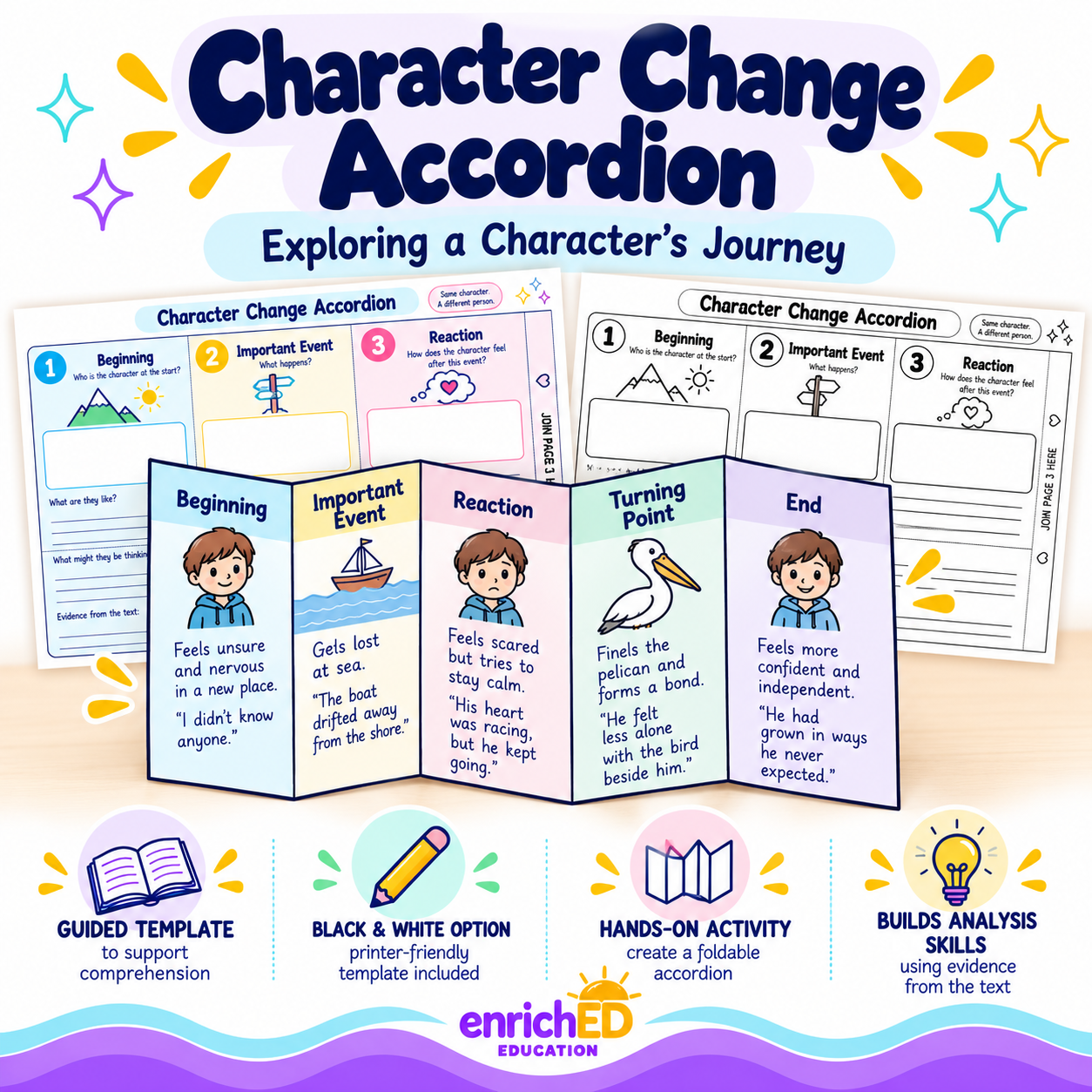
A creative, hands-on reading activity that helps students explore how characters grow and change throughout a story.
Students create a foldable accordion to represent a character's journey, identifying important events, changes in thoughts and feelings, and turning points that influence their development.
Using evidence from the text, students explain how and why a character changes, before reflecting on the themes and messages revealed through their journey.
Students will:
identify important events in a character's journey
describe changes in a character's thoughts, feelings and behaviour
recognise significant turning points
support their ideas with evidence from the text
explain how events influence character development
connect a character's journey to themes and messages
What's included:
Learning Intention and Success Criteria
Step-by-step activity instructions
Completed accordion worked example
Sentence starters to support student responses
Coloured accordion templates
Black-and-white, printer-friendly templates
Reflection and analysis questions
Student checklist and extension challenges
6-page teaching resource plus a separate 2-page printable BLM (8 pages total).
Suitable for reading groups, literature studies, independent comprehension tasks and whole-class reading activities.
Use with your own narrative texts – no specific book required.
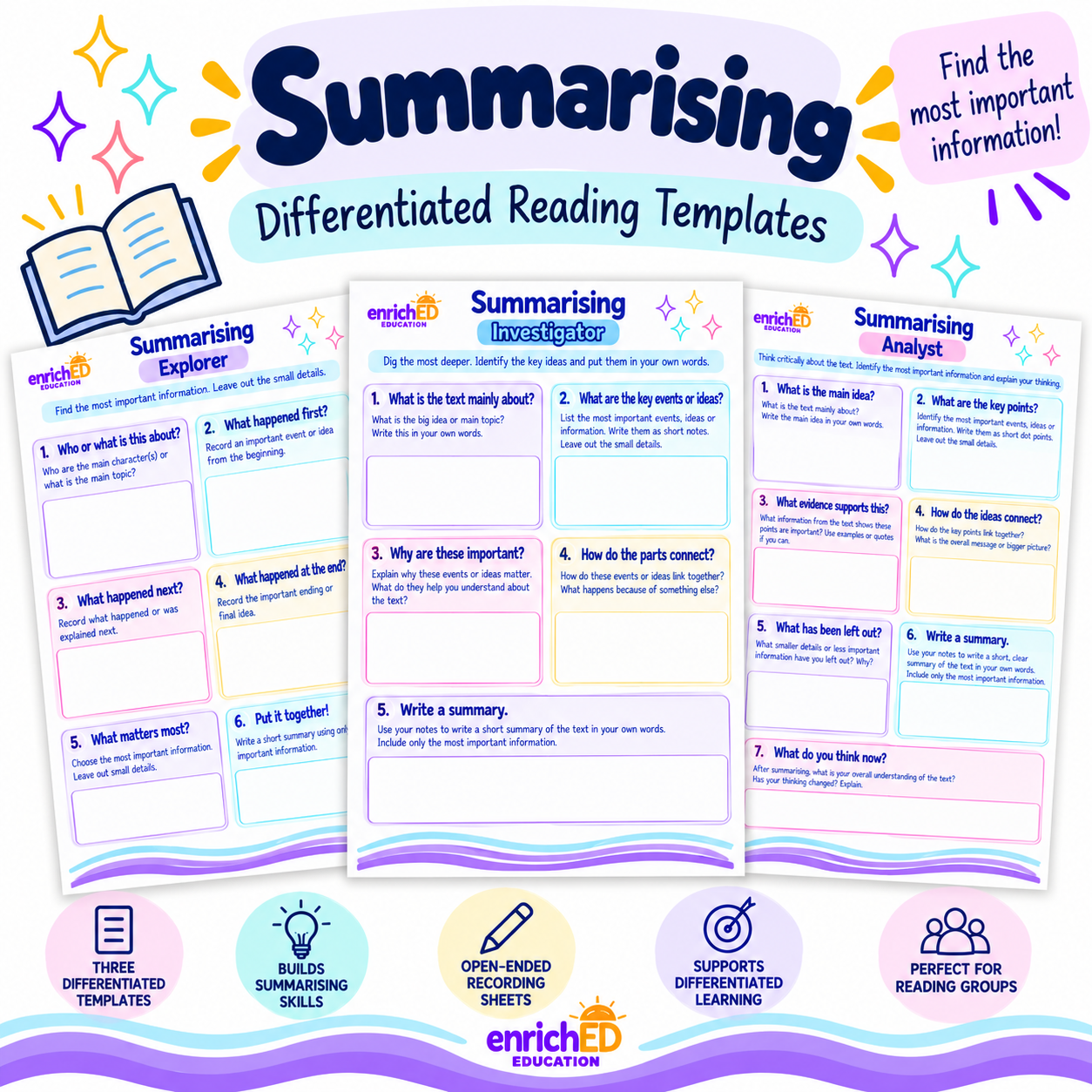
Help students identify key information, organise their thinking and write clear, concise summaries with these three differentiated reading templates.
Summarising is an essential reading comprehension skill that requires students to distinguish between important information and less relevant details.
These structured templates guide students through the summarising process, encouraging them to identify main ideas, sequence important events, explore connections and express their understanding in their own words.
With three levels of support and challenge, teachers can select the template that best suits each student's learning needs.
Students will:
Identify the main idea or topic of a text.
Recognise important events, ideas and information.
Distinguish key information from minor details.
Sequence events and explore connections between ideas.
Organise their thinking before writing.
Write clear summaries using their own words.
Reflect on their understanding of a text.
What's included:
Explorer: A highly scaffolded six-step template focusing on the main topic, sequencing events and identifying the most important information.
Investigator: A five-step template encouraging students to identify key ideas, explain their importance, explore connections and construct a summary.
Analyst: A more challenging seven-step template requiring students to justify key information using evidence, explore relationships between ideas and reflect on their understanding.
3-page printable PDF digital download.
Perfect for reading groups, guided reading, independent comprehension tasks, literature studies and formative assessment.
Suitable for use with a wide range of fiction and nonfiction texts – no specific book required.
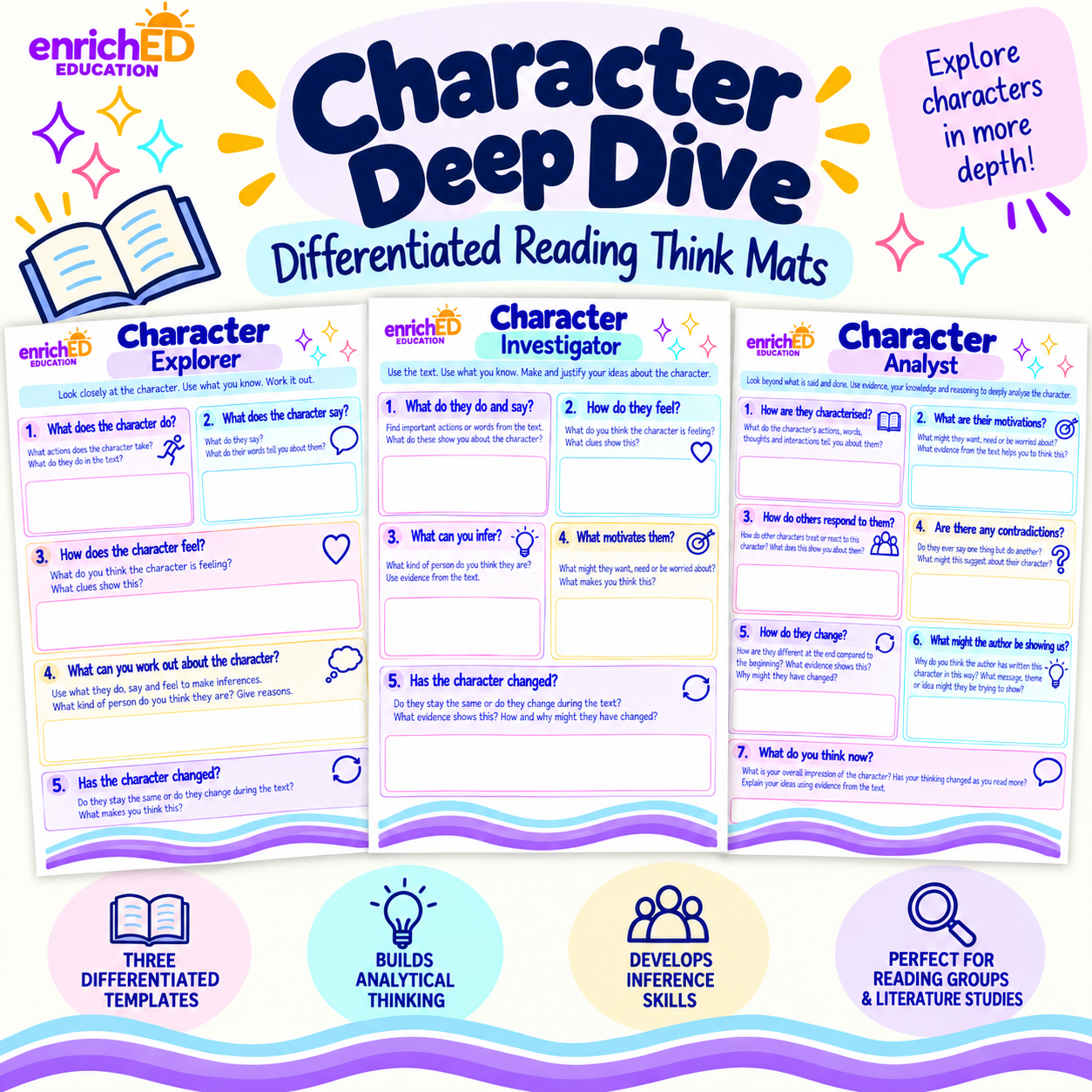
Help students look beyond a character's words and actions to develop deeper understanding, make inferences and support their thinking with evidence.
Understanding characters is an important reading comprehension skill. Students need to consider what characters say, do and feel, explore their motivations and recognise how characters change throughout a story.
These three differentiated think mats guide students through character analysis, encouraging them to use textual evidence, make thoughtful inferences and reflect on the author's choices.
With three levels of support and challenge, teachers can select the template that best suits each student's learning needs.
Students will:
Explore characters' actions, dialogue and feelings.
Make inferences about character traits and motivations.
Use evidence from the text to justify their thinking.
Examine how characters respond to events and other characters.
Identify and explain character development and change.
Consider how authors develop characters to communicate ideas and themes.
Reflect on and deepen their understanding of characters.
What's included:
Explorer: A scaffolded five-step think mat helping students explore what characters do, say and feel, make simple inferences and recognise character change.
Investigator: A five-step think mat encouraging students to use textual evidence, explore character motivations and explain how and why characters change.
Analyst: A more challenging seven-step think mat requiring students to analyse characterisation, motivations, relationships, contradictions, development and the author's intended message.
3-page printable PDF digital download.
Perfect for guided reading, reading groups, independent comprehension tasks, novel studies, literature discussions and formative assessment.
Suitable for use with a wide range of fiction texts – no specific book required.
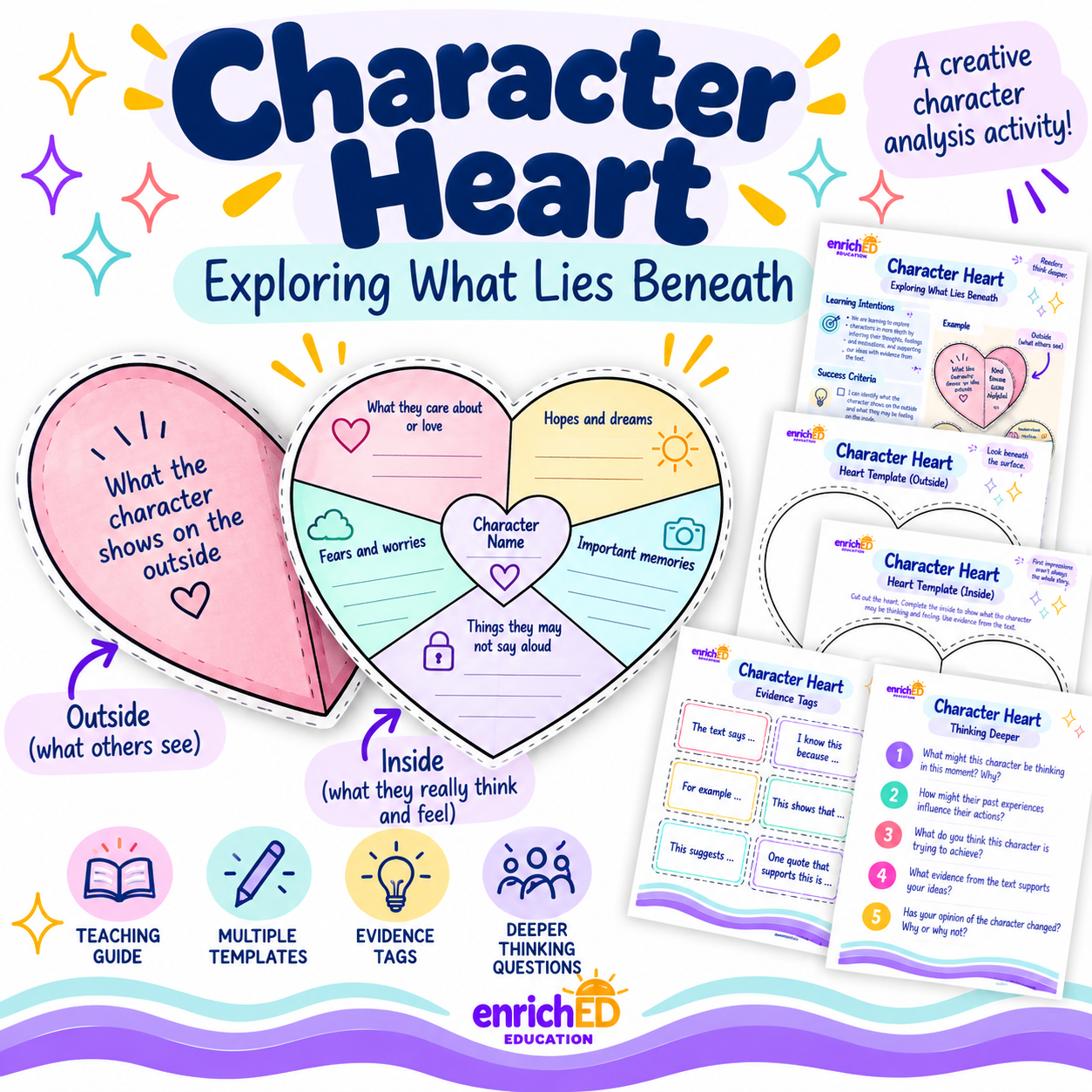
A creative, hands-on reading comprehension activity that encourages students to look beyond the surface and explore what a character is really thinking and feeling.
Students create an interactive foldable heart to investigate the difference between what a character shows others and what lies beneath. They explore a character's hopes, fears, important memories, motivations and hidden thoughts, using evidence from the text to support their ideas.
This engaging activity encourages deeper thinking, inference and meaningful discussion about character development.
Students will:
Identify what a character shows on the outside and what they may be feeling on the inside.
Infer thoughts, feelings and motivations using clues from the text.
Explore a character's hopes, fears, memories and values.
Support their interpretations with evidence from the text.
Explain how a character's internal feelings influence their actions.
Reflect on their understanding of a character through deeper-thinking questions.
What's included:
Learning Intention and Success Criteria
Step-by-step activity instructions
Completed worked example
Sentence starters to support student responses
Coloured outside and inside heart templates
Printable evidence tags
Thinking Deeper comprehension and reflection questions
Black-and-white, printer-friendly activity pages
9-page printable PDF digital download.
Perfect for reading groups, literature studies, independent comprehension activities and whole-class character analysis.
Suitable for use with a wide range of narrative texts – no specific book required.
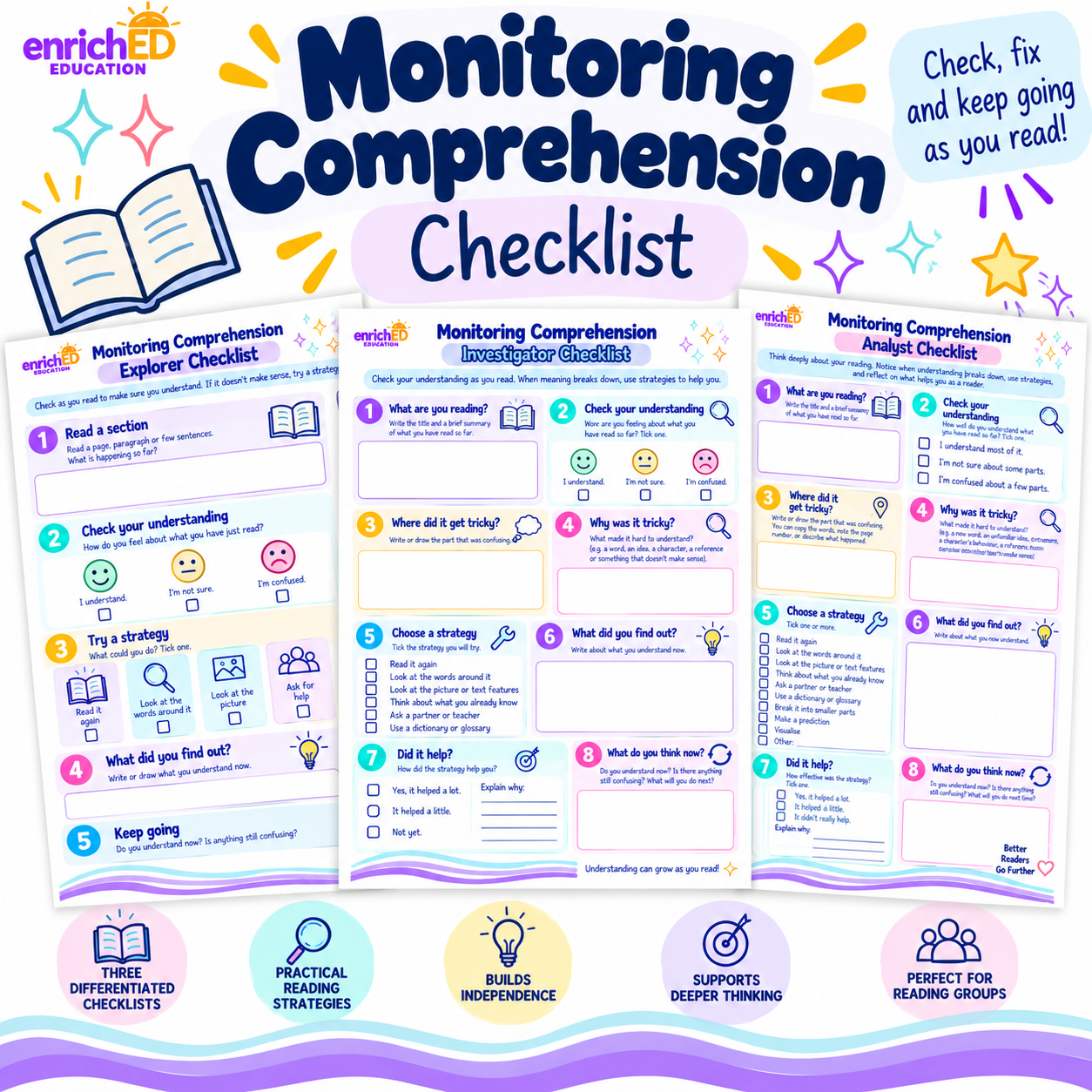
Help students become more independent, reflective readers with these differentiated reading comprehension self-assessment checklists.
Good readers recognise when something doesn't make sense and know how to use strategies to improve their understanding.
These three differentiated checklists encourage students to pause during reading, assess their comprehension, identify areas of confusion and select strategies to help them make meaning from a text.
Students then reflect on whether their chosen strategy was effective, developing greater awareness of themselves as readers.
Students will:
Monitor and self-assess their understanding while reading.
Recognise when comprehension breaks down.
Identify words, ideas or sections they find confusing.
Select and apply appropriate comprehension strategies.
Reflect on whether a strategy improved their understanding.
Develop independence and confidence as readers.
What's included:
Explorer Checklist: A highly scaffolded five-step checklist with visual prompts and simple comprehension strategies.
Investigator Checklist: An eight-step checklist encouraging students to identify difficulties, select strategies and evaluate their effectiveness.
Analyst Checklist: A more detailed checklist encouraging deeper reflection, strategic thinking and evaluation of comprehension strategies.
3-page printable PDF digital download.
Perfect for independent reading, guided reading groups, reading conferences and formative assessment.
Suitable for use with a wide range of texts and adaptable to different reading abilities.
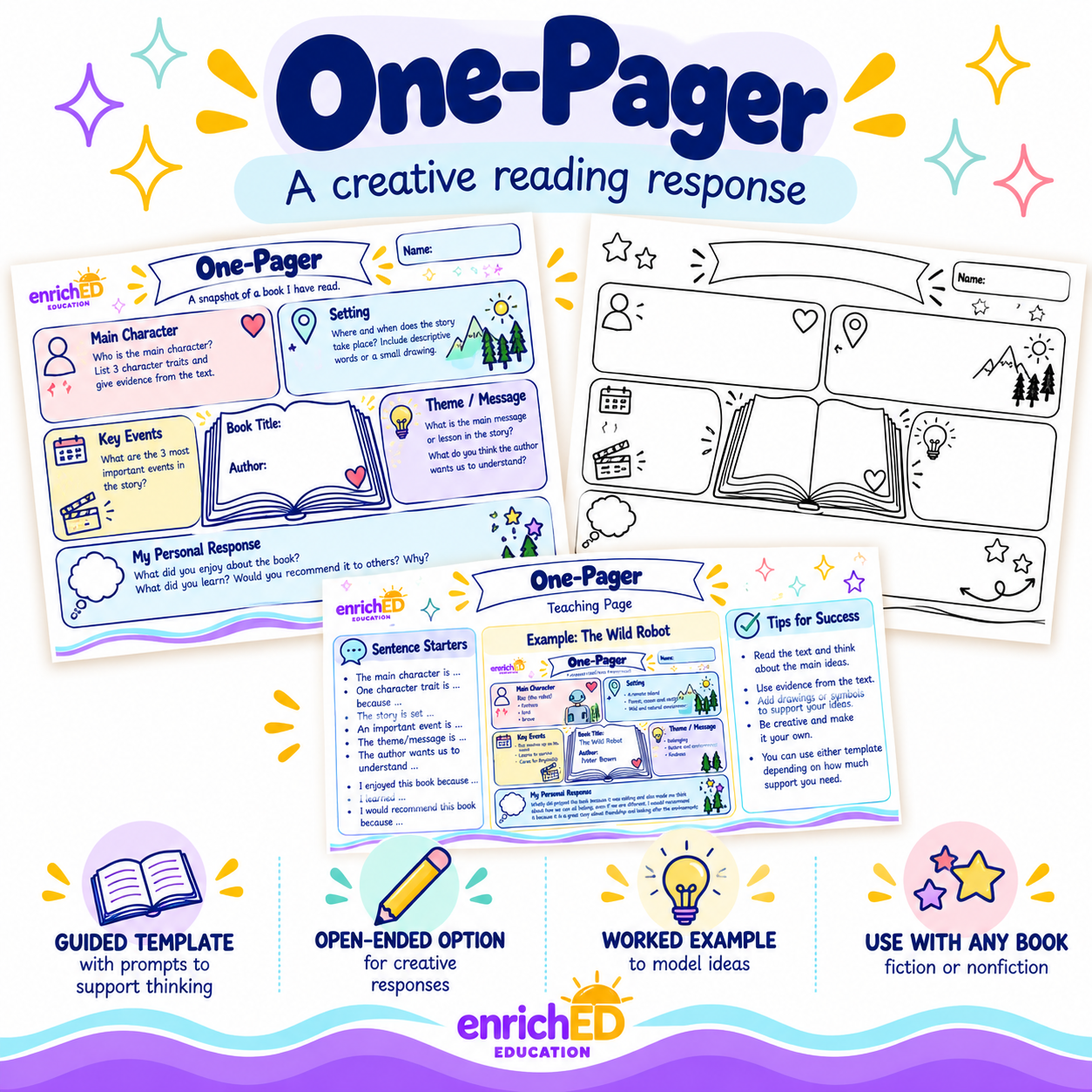
A creative, open-ended reading activity that encourages students to demonstrate their understanding of a book through words, illustrations and personal reflection.
Students create a visual snapshot of a book they have read, exploring important elements such as characters, setting, key events, themes and personal responses.
With two different templates, sentence starters and a completed worked example using The Wild Robot, this resource provides the support students need while encouraging creativity and independent thinking.
Students will:
identify and describe main characters and their traits
explore the setting and important events
identify themes and messages
support their ideas with evidence from the text
express personal responses and reflections
communicate their understanding through writing, symbols and illustrations
What's included:
Guided one-pager template with comprehension prompts
Open-ended black-and-white one-pager template
Teaching guide with instructions and suggestions
Sentence starters to support student responses
Completed worked example using The Wild Robot
4-page printable PDF digital download.
Suitable for reading groups, independent reading responses, literature studies and whole-class activities.
Use with a wide range of fiction texts – no additional worksheets required.