
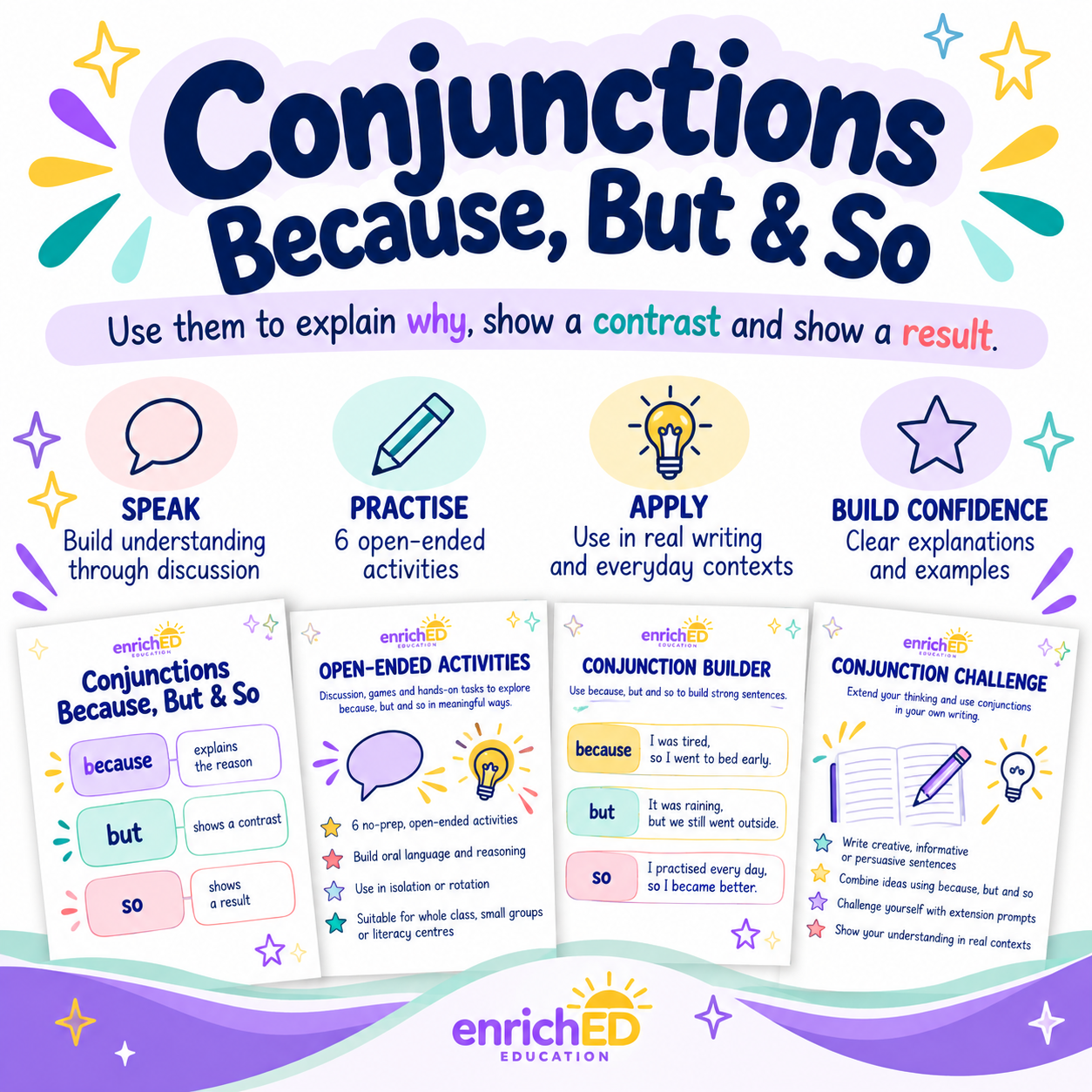
A practical grammar resource that helps students understand how because, but and so connect ideas and change meaning.
Students explore how because explains why, but introduces a change or contrast, and so shows a result. Through discussion, sentence building and writing activities, students practise choosing the right conjunction and using it to create clear, meaningful sentences.
Students will:
identify because, but and so in sentences and texts
explain what each conjunction tells the reader
choose the correct conjunction to connect ideas
build and improve sentences
explore how changing the conjunction changes meaning
apply conjunctions in their own writing
What’s included:
Learning Intention and Success Criteria
explicit teaching and worked examples
sentence structure and punctuation guidance
6 open-ended oral language activities
Conjunction Builder activity
sentence-writing practice
Conjunction Challenge
real-world writing task
5-page printable PDF digital download.
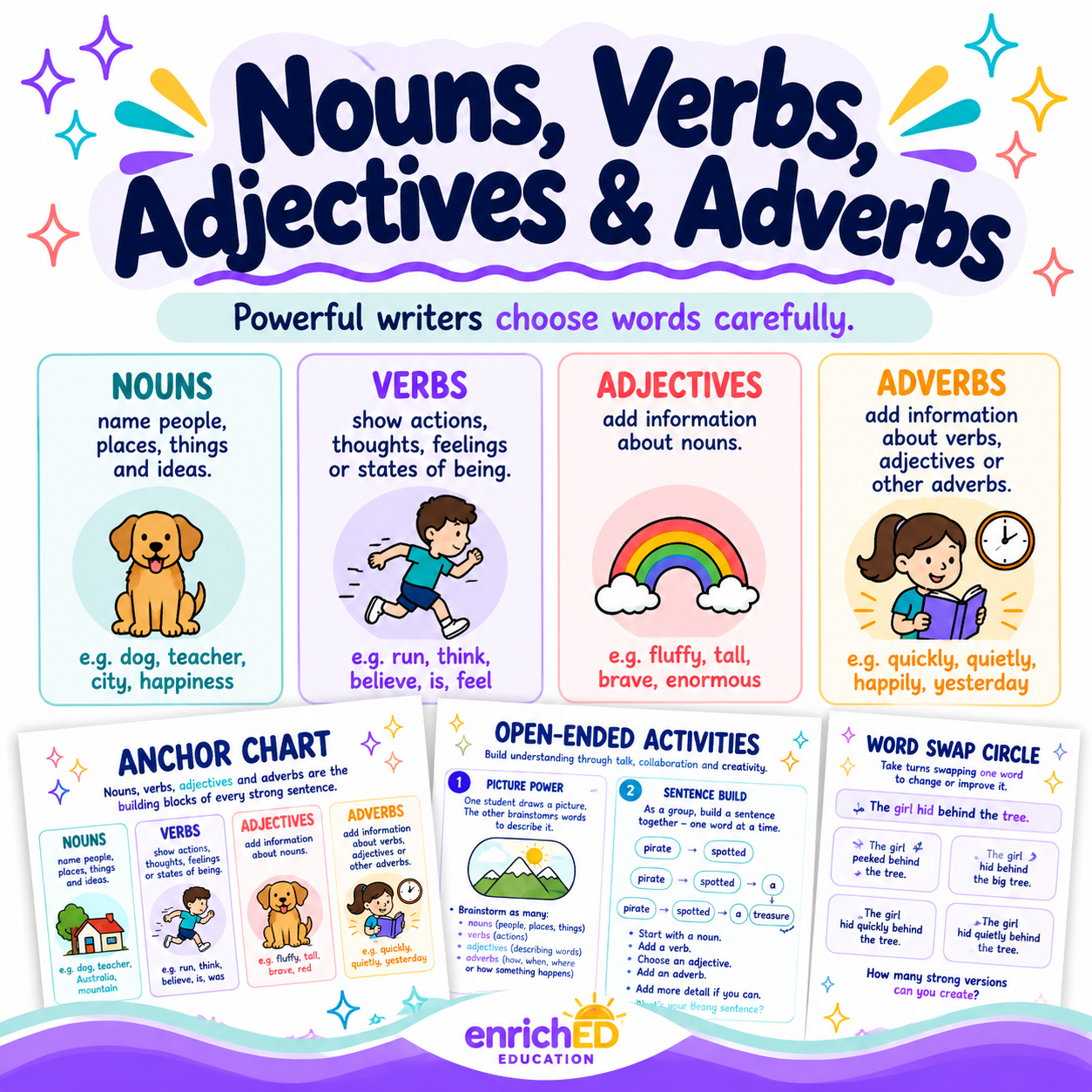
A practical grammar resource that helps students understand how different word types work together to create stronger sentences.
Students explore nouns, verbs, adjectives and adverbs through discussion, sentence building and deliberate word choice. The activities encourage students to move beyond simply identifying parts of speech and think about how changing words can improve meaning and impact in their writing.
Students will:
identify nouns, verbs, adjectives and adverbs
explain the role each word type plays in a sentence
build and expand sentences
experiment with changing words to alter meaning
make deliberate word choices to strengthen their writing
What's included:
Learning Intention and Success Criteria
parts of speech anchor chart
open-ended oral language and collaborative activities
sentence-building activities
word sorting and explaining tasks
Word Swap Circle activity
independent practice worksheets
7-page printable PDF digital download.
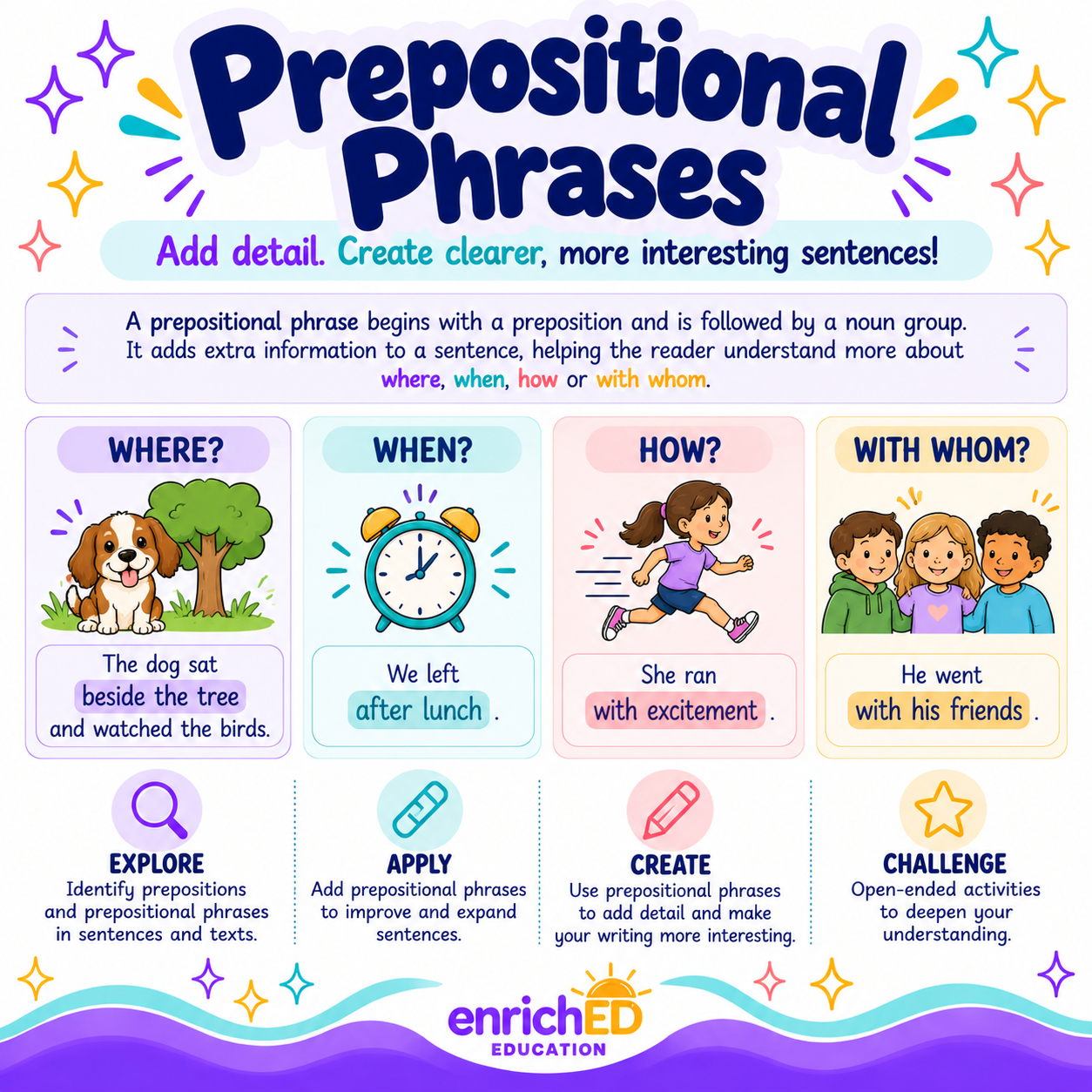
A practical grammar resource that helps students use prepositional phrases to add detail and create clearer, more interesting sentences.
Students explore how prepositional phrases provide extra information about where, when, how or with whom. Through discussion, investigation and sentence-building activities, students learn to identify prepositional phrases and use them purposefully to expand and improve their own writing.
Students will:
identify prepositions and prepositional phrases
understand how prepositional phrases add information
recognise details about where, when, how and with whom
expand simple sentences using prepositional phrases
experiment with moving phrases within sentences
apply prepositional phrases to their own writing
What's included:
Learning Intention and Success Criteria
prepositional phrases anchor chart
6 open-ended activities
sentence detail challenge
Prepositional Phrase Detective activity
opportunities for speaking, writing and collaborative learning
5-page printable PDF digital download.
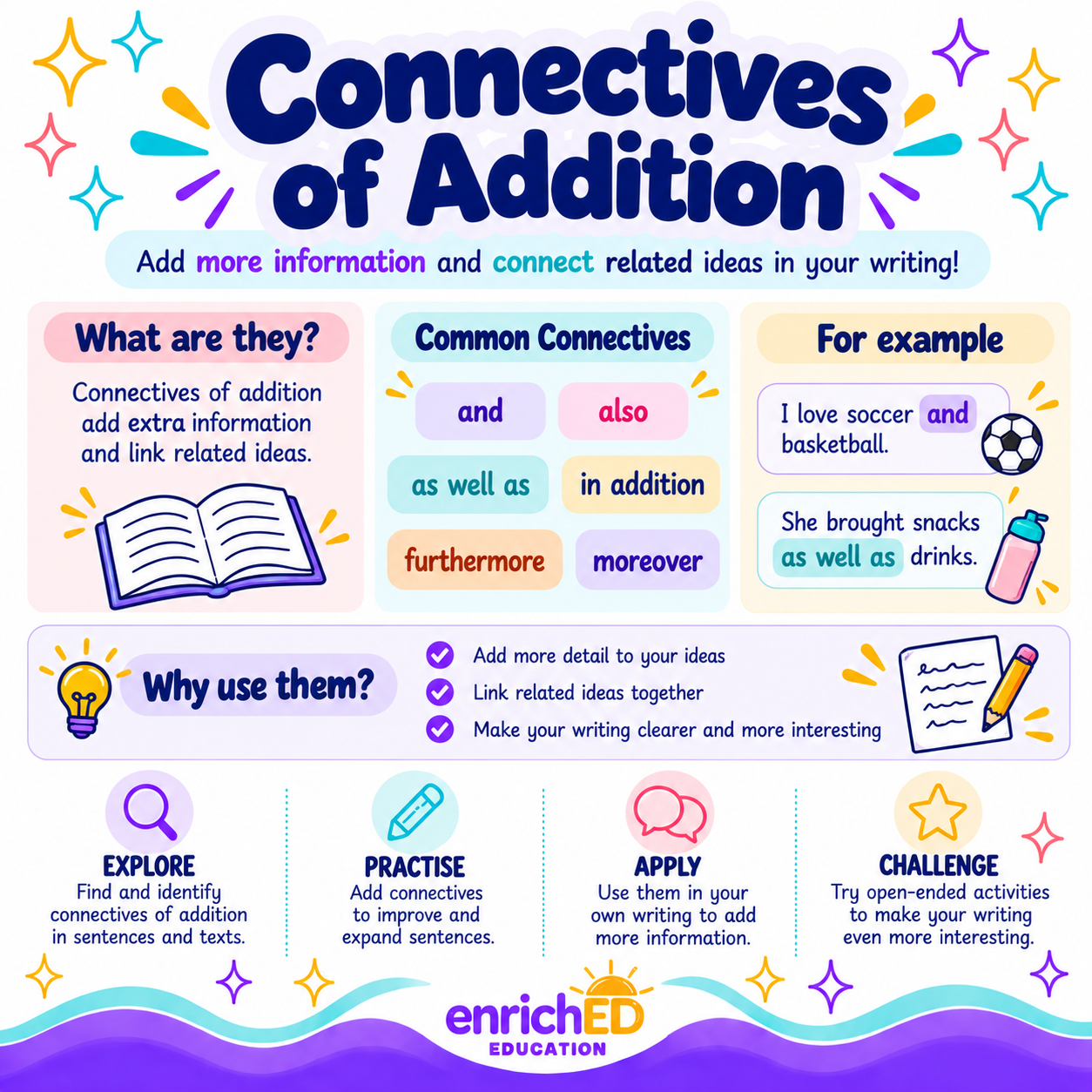
A practical grammar resource that helps students use connectives of addition to add information, link related ideas and make their writing clearer and more cohesive.
Students explore connectives such as and, also, as well as, in addition, additionally, furthermore and moreover. They learn how these connectives work within and across sentences before applying them to expand ideas and strengthen their own writing.
Students will:
identify connectives of addition
understand how connectives add and link information
explore different ways additive connectives can be used in sentences
expand sentences by adding related details
choose connectives purposefully
apply connectives of addition in their own writing
What's included:
Learning Intention and Success Criteria
Connectives of Addition anchor chart
punctuation guidance and worked examples
6 open-ended activities
Addition Builder activity
Addition Challenge activity
oral language and collaborative activities
independent sentence-writing practice
5-page printable PDF digital download.
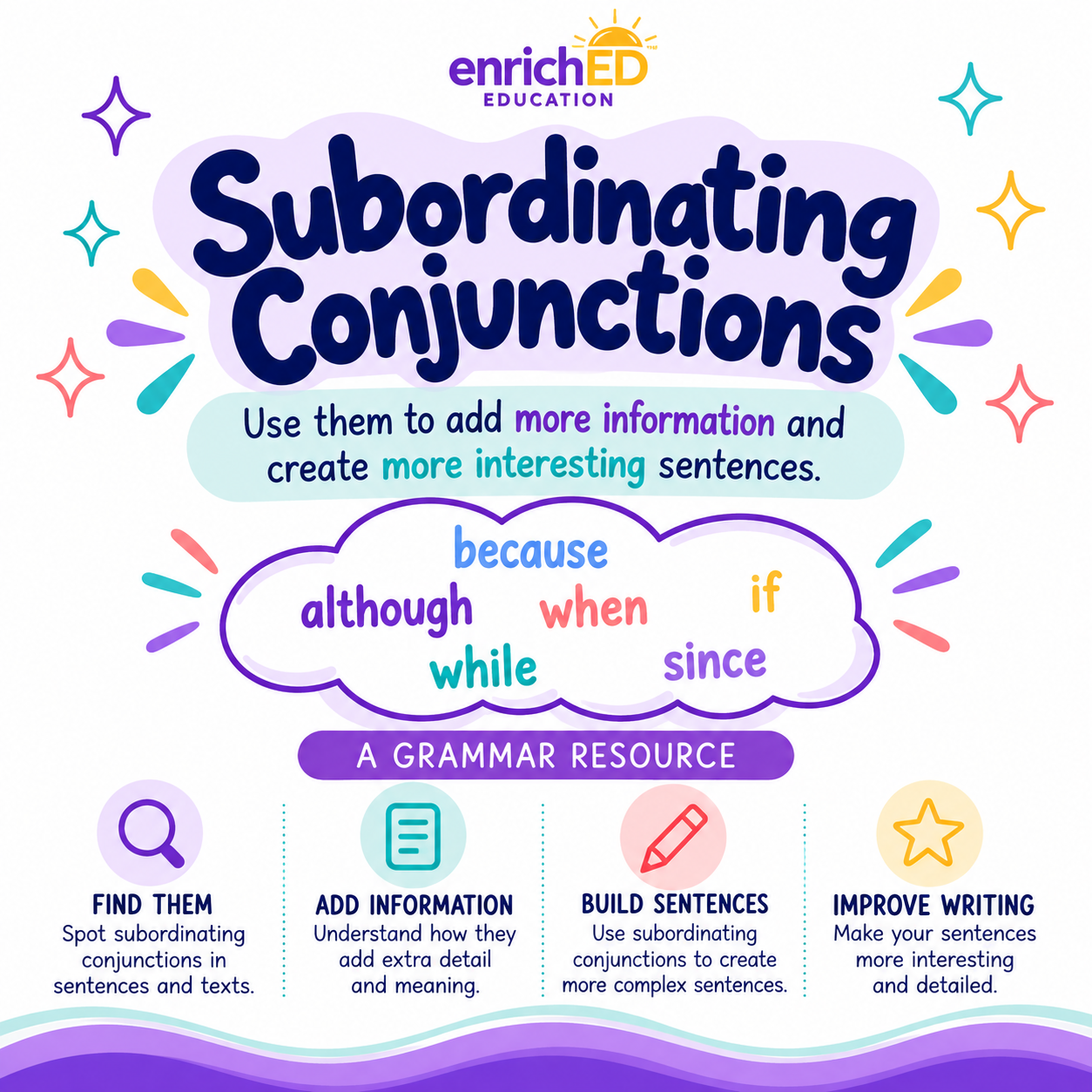
A practical grammar resource that helps students understand how subordinating conjunctions connect ideas and show relationships between them.
Students explore how subordinating conjunctions can show time, reason, contrast and condition. Through discussion, sentence building and writing activities, students learn to identify conjunctions, understand the relationship they create and use them to build more detailed and interesting sentences.
Students will:
identify subordinating conjunctions in sentences and texts
explain the relationship a conjunction shows
distinguish between time, reason, contrast and condition
choose conjunctions that match the intended meaning
build and improve complex sentences
apply subordinating conjunctions in their own writing
What’s included:
Learning Intention and Success Criteria
explicit teaching and worked examples
sentence structure and punctuation guidance
6 open-ended oral language activities
Conjunction Builder activity
sentence-writing practice
Conjunction Challenge
real-world writing task
5-page printable PDF digital download.
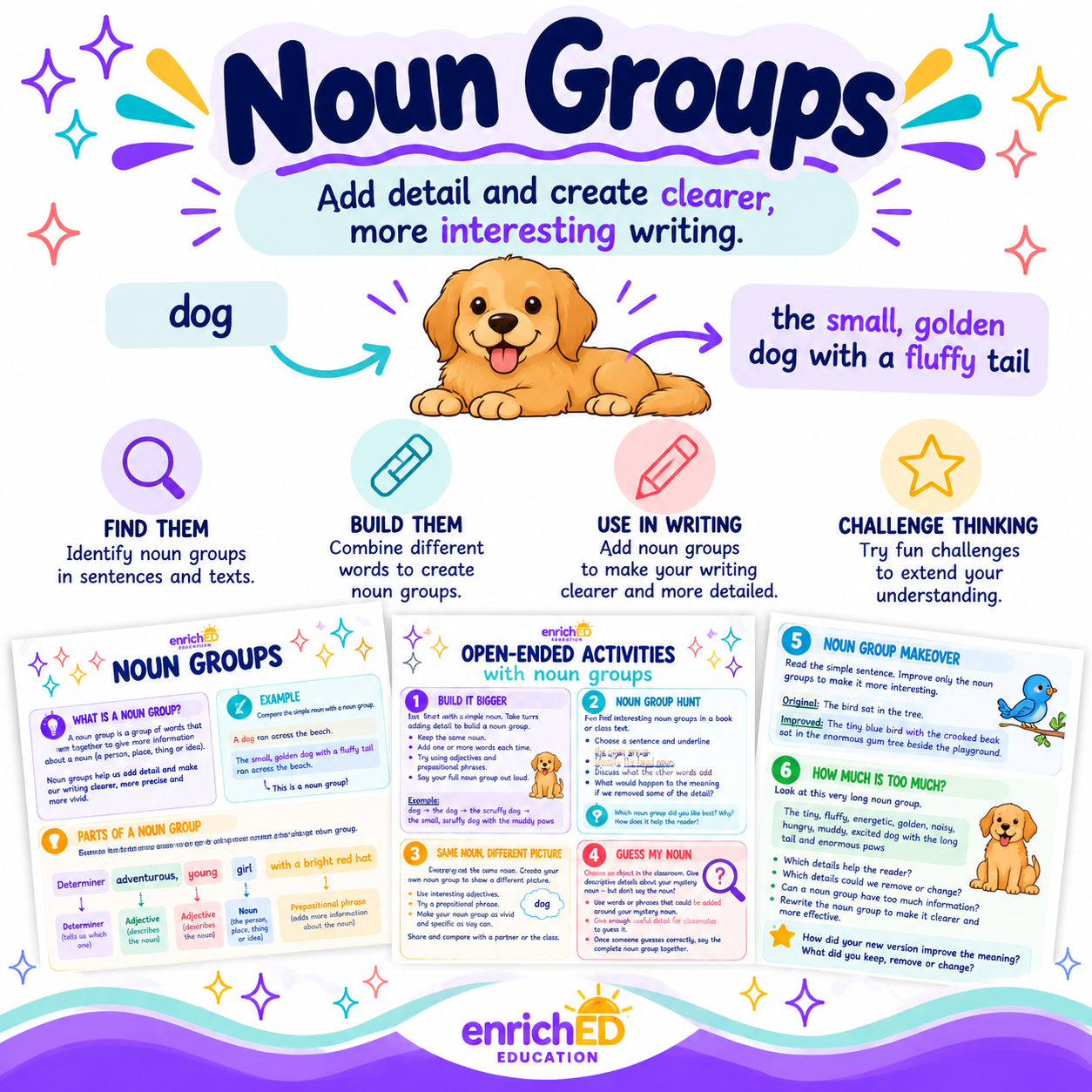
A practical grammar resource that helps students add detail and create clearer, more interesting writing.
Students explore how noun groups work and learn to build them by adding carefully chosen words and phrases around a noun. Through discussion, sentence building and writing activities, students experiment with noun groups and consider how much detail is useful.
Students will:
identify noun groups in sentences and texts
understand the different words that can form a noun group
expand simple nouns with meaningful detail
use noun groups to create clearer and more vivid writing
refine noun groups by adding, removing or changing details
What's included:
Learning Intention and Success Criteria
noun groups anchor chart
6 open-ended activities
Noun Group Makeover activity
How Much Is Too Much? reasoning activity
opportunities for speaking, writing and collaborative learning
5-page printable PDF digital download.
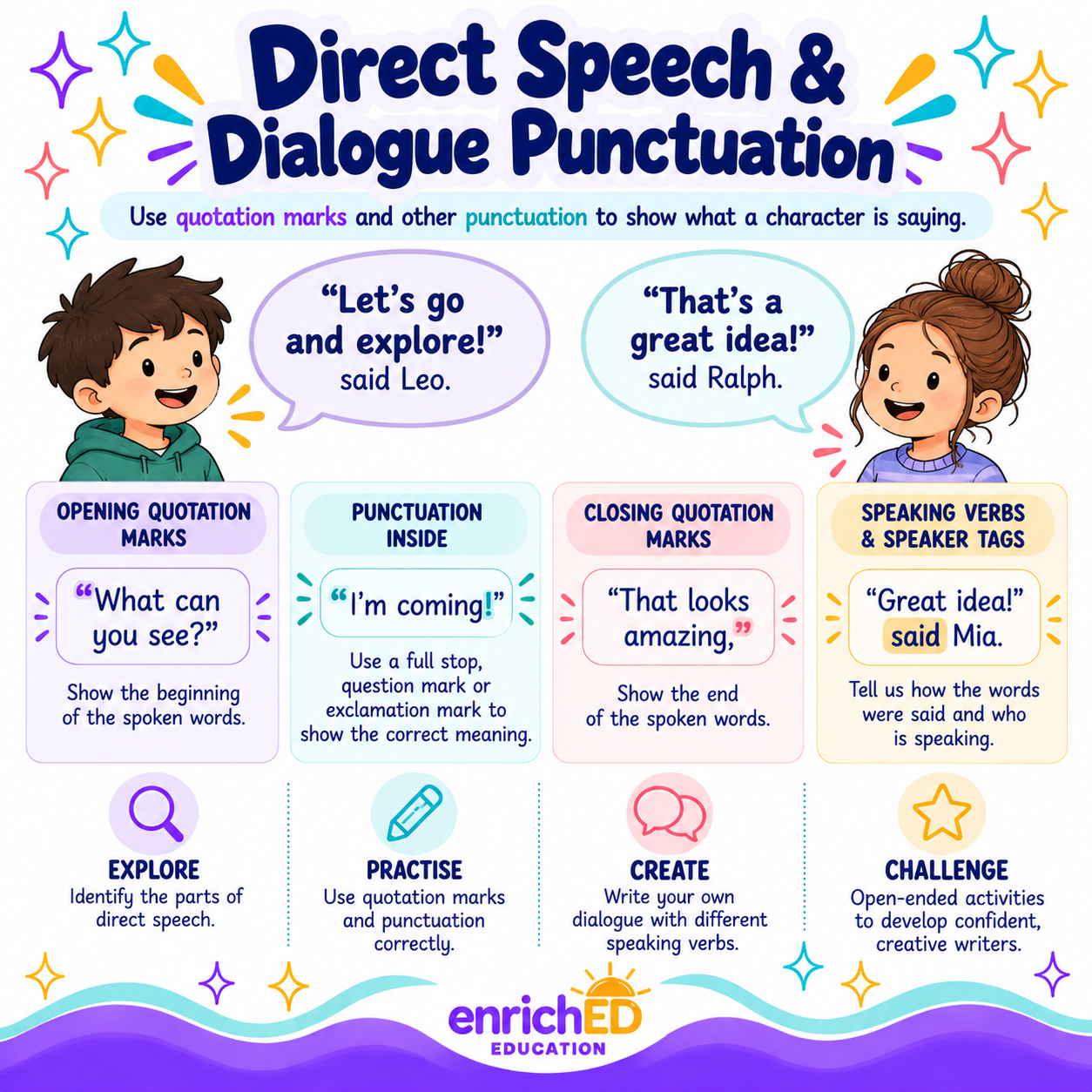
A practical grammar resource that helps students punctuate direct speech correctly and use dialogue to make their writing more engaging.
Students learn how quotation marks, capital letters and punctuation work together to show exactly what a character is saying. They also explore speaking verbs, speaker tags and character actions before applying these skills to create and improve their own dialogue.
Students will:
identify the parts of direct speech
use quotation marks, capital letters and punctuation correctly
identify and use speaker tags
choose purposeful speaking verbs
add character actions to strengthen dialogue
create and improve dialogue in their own writing
What's included:
Learning Intention and Success Criteria
direct speech punctuation anchor chart
speaking verb examples
6 open-ended activities
Build & Punctuate Direct Speech worksheet
Dialogue in Action worksheet
editing and correcting punctuation tasks
independent dialogue-writing activity
5-page printable PDF digital download.
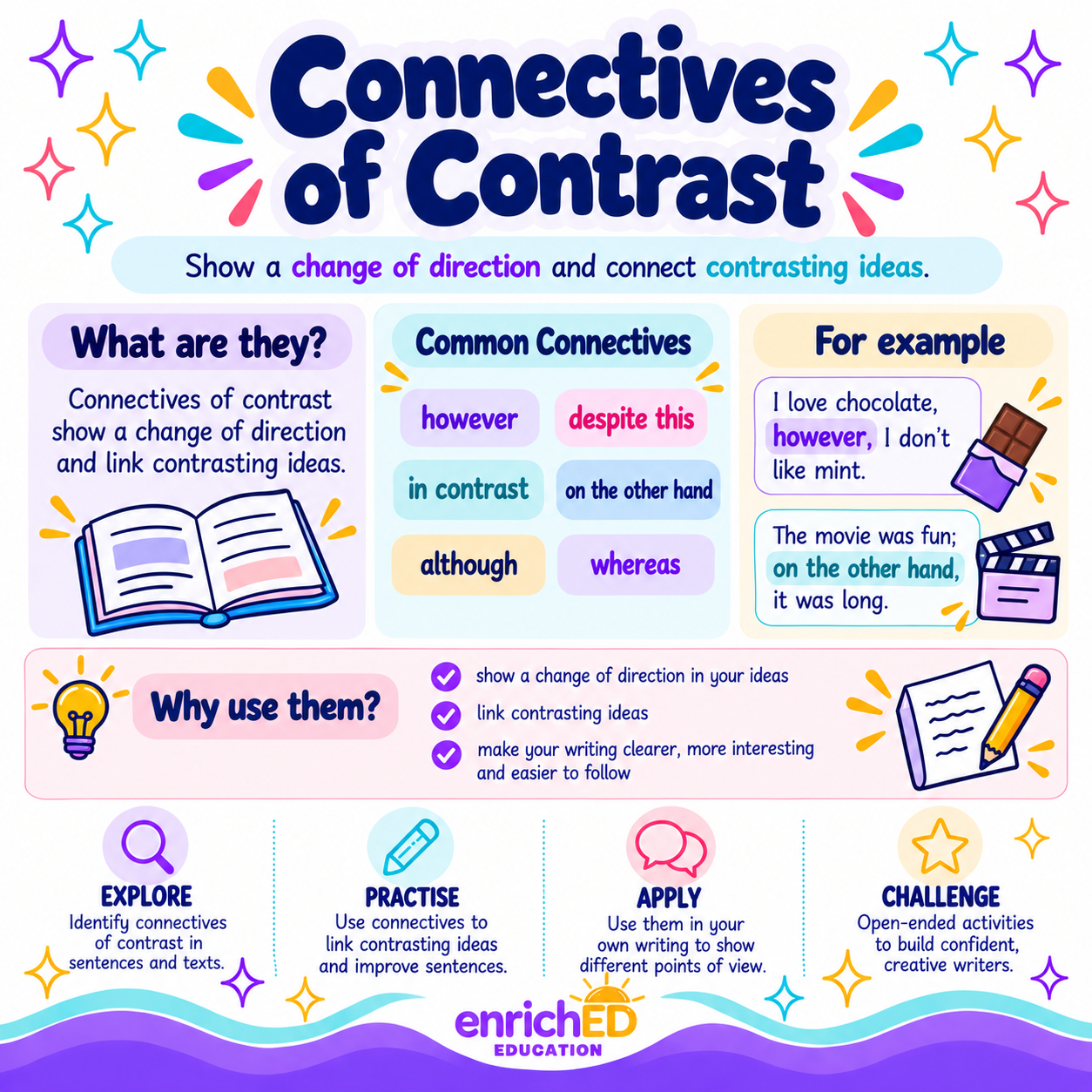
A practical grammar resource that helps students use connectives of contrast to show differences, link contrasting ideas and make their writing clearer and more cohesive.
Students explore connectives such as however, on the other hand, in contrast, despite this, although and whereas. They learn how these connectives signal a change in direction or introduce an opposing idea, before applying them to build stronger sentences and express contrasting viewpoints.
Students will:
identify connectives of contrast
understand how connectives signal contrasting ideas
compare different or opposing ideas
use contrast connectives appropriately within their writing
apply appropriate punctuation
choose from a range of connectives to avoid repetition
What's included:
Learning Intention and Success Criteria
Connectives of Contrast anchor chart
punctuation guidance and worked examples
6 open-ended activities
Contrast Builder activity
Contrast Challenge activity
oral language and collaborative practice
independent sentence-writing opportunities
5-page printable PDF digital download.
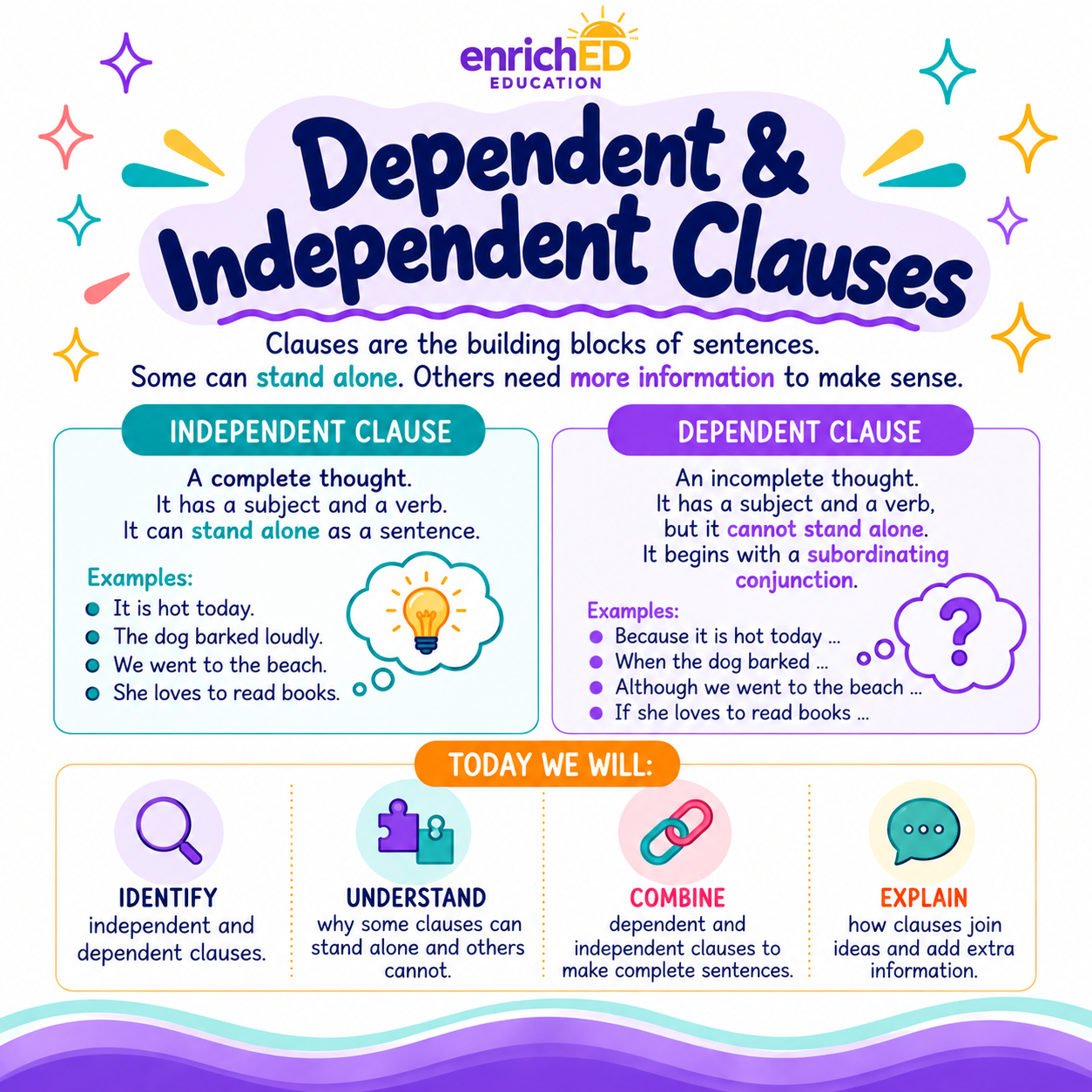
A practical grammar resource that helps students understand how clauses work together to build complete sentences.
Students learn to distinguish between independent clauses, which can stand alone as complete thoughts, and dependent clauses, which need more information to make sense. Through discussion, clause building and writing activities, students practise identifying, combining and manipulating clauses to create complete sentences. EnrichED_Dependent_and_Independ…
Students will:
identify independent and dependent clauses
explain why a clause can or cannot stand alone
recognise the role of subordinating conjunctions
combine dependent and independent clauses
build and improve complete sentences
apply their understanding in their own writing
What’s included:
Learning Intention and Success Criteria
explicit teaching and worked examples
independent vs dependent clause comparison
6 open-ended oral language activities
Clause Builder activities
sentence combining and sentence surgery
sorting and reasoning tasks
final writing challenge
5-page printable PDF digital download.
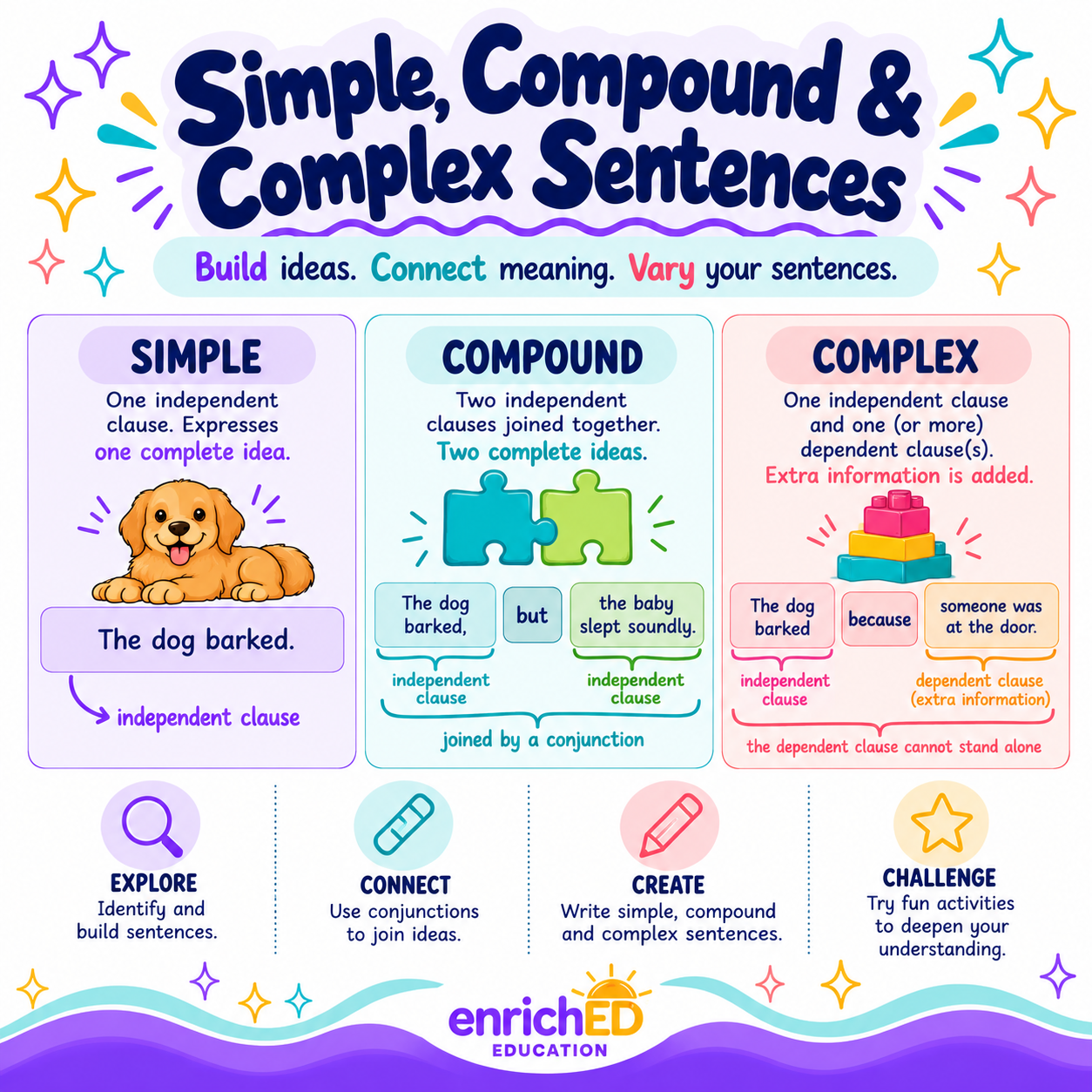
A comprehensive grammar resource that helps students understand, build and confidently use simple, compound and complex sentences.
Students explore how clauses are combined to create different sentence structures and how writers can deliberately vary their sentences to express ideas clearly. The resource moves from explicit teaching and worked examples through to open-ended, scaffolded and independent practice.
Students will:
identify independent and dependent clauses
recognise simple, compound and complex sentences
combine ideas using coordinating and subordinating conjunctions
transform ideas into different sentence structures
compare how sentence structures affect meaning
vary sentence structures purposefully in their writing
What's included:
Learning Intention and Success Criteria
simple, compound and complex sentence teaching guide
clause and sentence structure anchor charts
7 open-ended activities
scaffolded sentence-combining practice
independent application activities
picture-prompt writing task
reflection and extension opportunities
teacher guide with suggested teaching sequence
7-page printable PDF digital download.
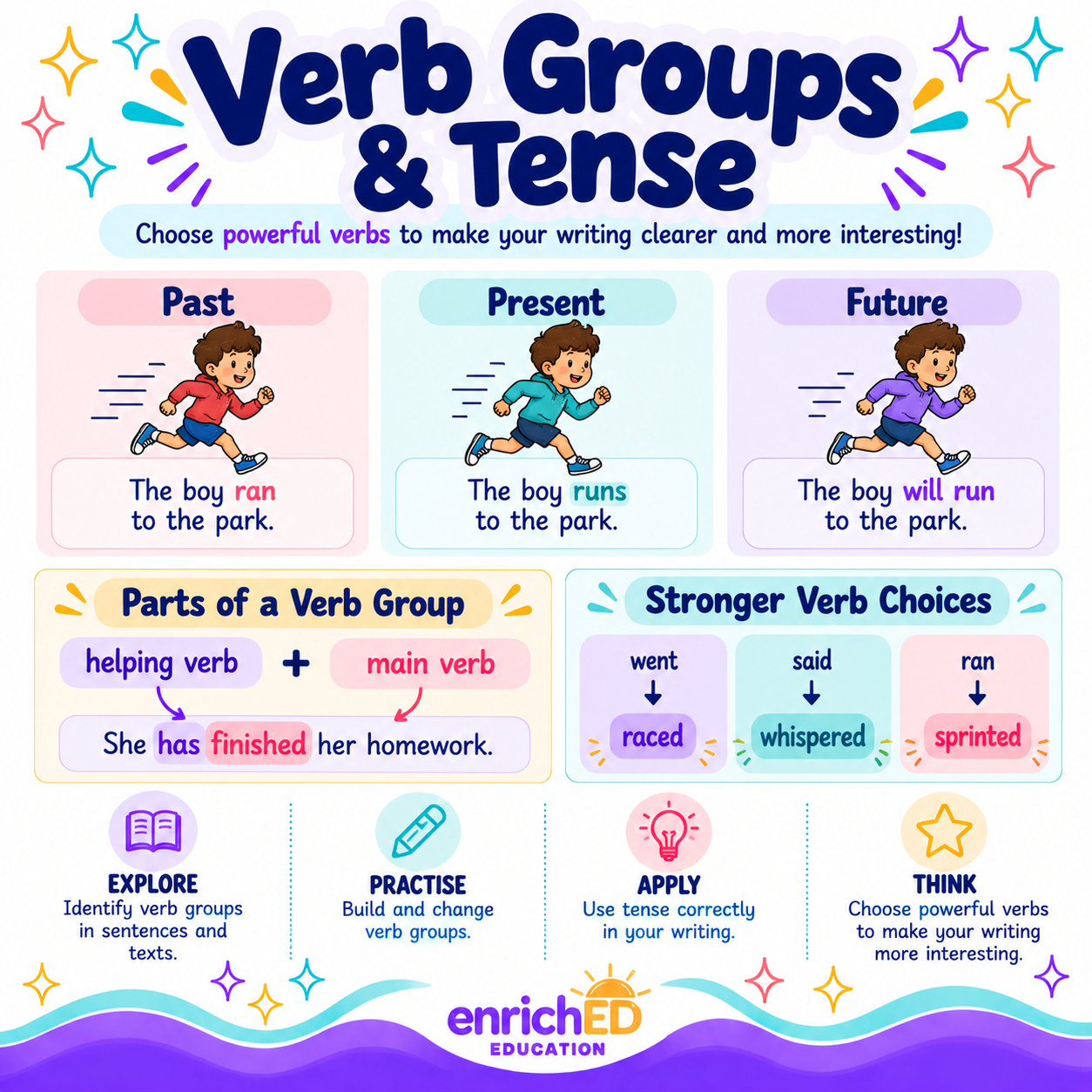
A practical grammar resource that helps students understand verb groups, maintain consistent tense and make stronger verb choices in their writing.
Students explore how main verbs and helping verbs work together to form verb groups and show past, present and future tense. They build and change verb groups, investigate verbs in texts, correct tense errors and experiment with more precise and powerful verb choices.
Students will:
identify complete verb groups in sentences
distinguish between helping verbs and main verbs
recognise and use past, present and future tense
maintain consistent tense in their writing
build and change verb groups
choose stronger verbs to make writing clearer and more engaging
What's included:
Learning Intention and Success Criteria
Verb Groups & Tense anchor chart
6 open-ended activities
verb group identification and building tasks
tense-changing activities
editing and correcting tense errors
stronger verb choice activities
independent writing challenge
5-page printable PDF digital download.
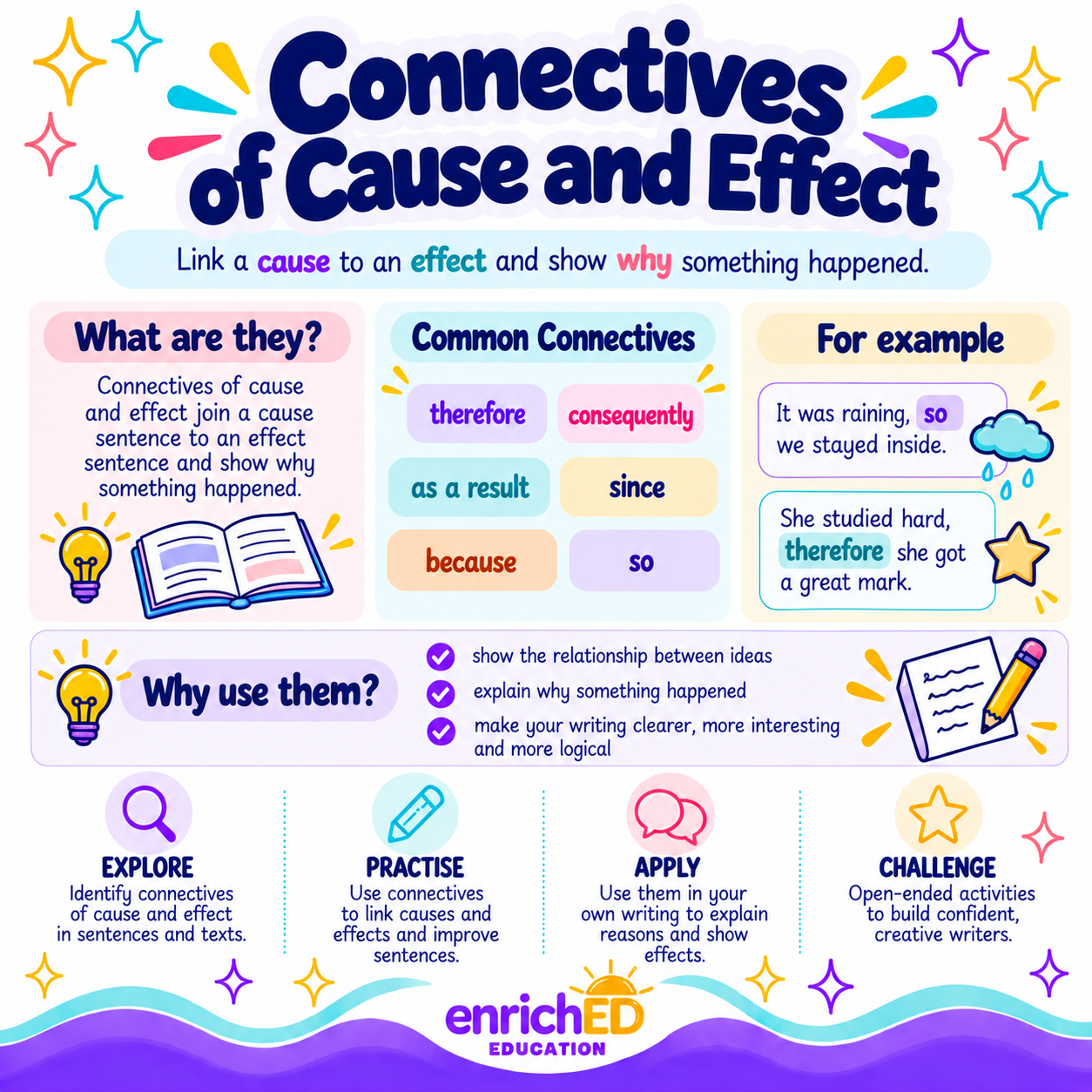
A practical grammar resource that helps students use connectives of cause and effect to link ideas, explain why something happened and show what happened as a result.
Students explore connectives such as therefore, consequently, as a result and since. They learn to recognise the relationship between a cause and its effect, choose an appropriate connective, and use these connections to make their speaking and writing clearer and more logical.
Students will:
identify cause and effect relationships
identify connectives of cause and effect in sentences and texts
explain how connectives link a cause to an effect
choose appropriate connectives for different sentences
experiment with different ways to express the same relationship
apply cause and effect connectives in their own writing
What's included:
Learning Intention and Success Criteria
Connectives of Cause and Effect anchor chart
worked examples and sentence patterns
punctuation guidance
6 open-ended activities
Cause & Effect Builder activity
Cause & Effect Challenge activity
oral language and collaborative practice
independent writing opportunities
5-page printable PDF digital download.
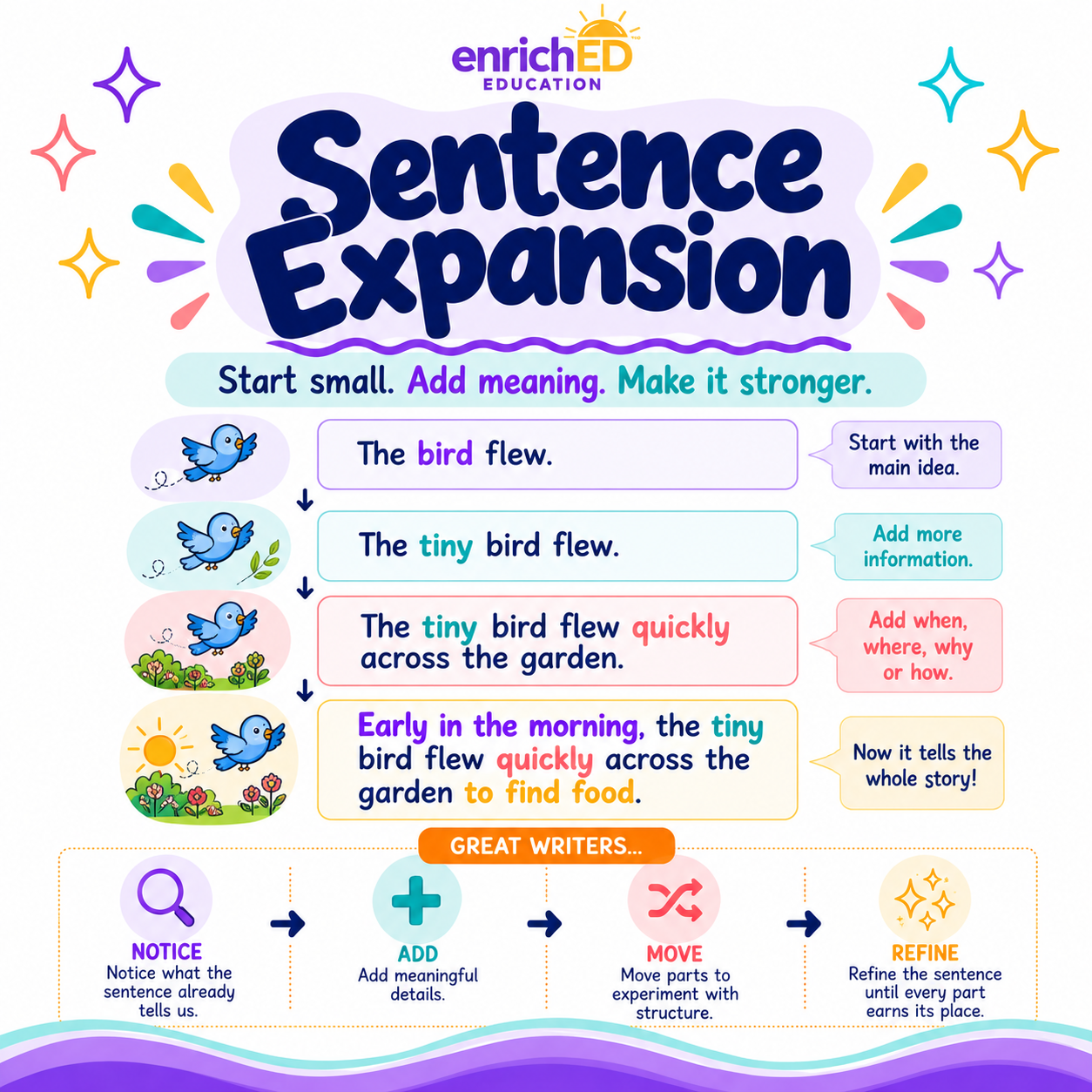
A practical writing resource that helps students turn simple sentences into richer, more detailed and meaningful writing.
Students begin with a simple kernel sentence and learn how to expand it by adding purposeful details about who, when, where, why and how. They also explore how moving details within a sentence can change emphasis and improve the flow of their writing.
Students will:
identify the important parts of a sentence
add meaningful details to expand ideas
use who, when, where, why and how to guide sentence expansion
experiment with moving details within sentences
choose details that improve meaning rather than simply adding more words
reread and refine expanded sentences
What’s included:
Learning Intention and Success Criteria
explicit teaching and worked examples
sentence expansion anchor chart
6 open-ended oral language activities
Build It Bigger! activity
2 student practice worksheets
opportunities to discuss, build, move and refine sentences
Teacher Guide with Victorian Curriculum 2.0 connections and suggested teaching sequence
7-page printable PDF digital download.
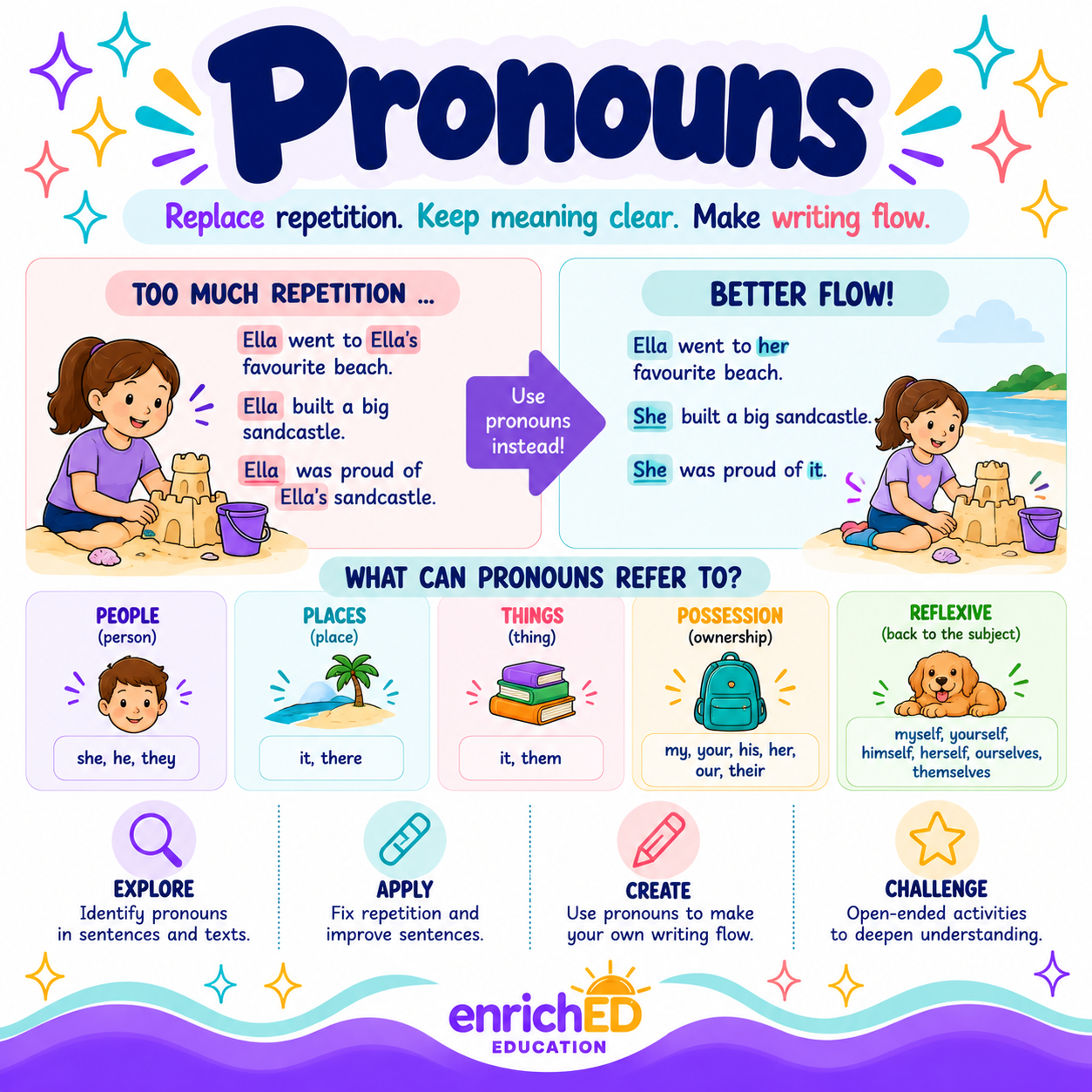
A practical grammar resource that helps students use pronouns to avoid repetition, maintain clear meaning and improve the flow of their writing.
Students explore how pronouns replace nouns and learn why a pronoun needs to have a clear reference. They identify different types of pronouns, fix confusing sentences and apply their understanding to their own writing.
Students will:
identify pronouns and the nouns they refer to
use pronouns to avoid unnecessary repetition
explore personal, possessive, reflexive, demonstrative and indefinite pronouns
recognise and fix unclear pronoun references
use pronouns to make writing clearer and more cohesive
apply pronouns purposefully in their own writing
What's included:
Learning Intention and Success Criteria
pronouns anchor chart
6 open-ended activities
Pronoun Makeover activity
independent writing application
teacher guide
differentiation, assessment and next-step ideas
Victorian Curriculum 2.0 connection
5-page printable PDF digital download.
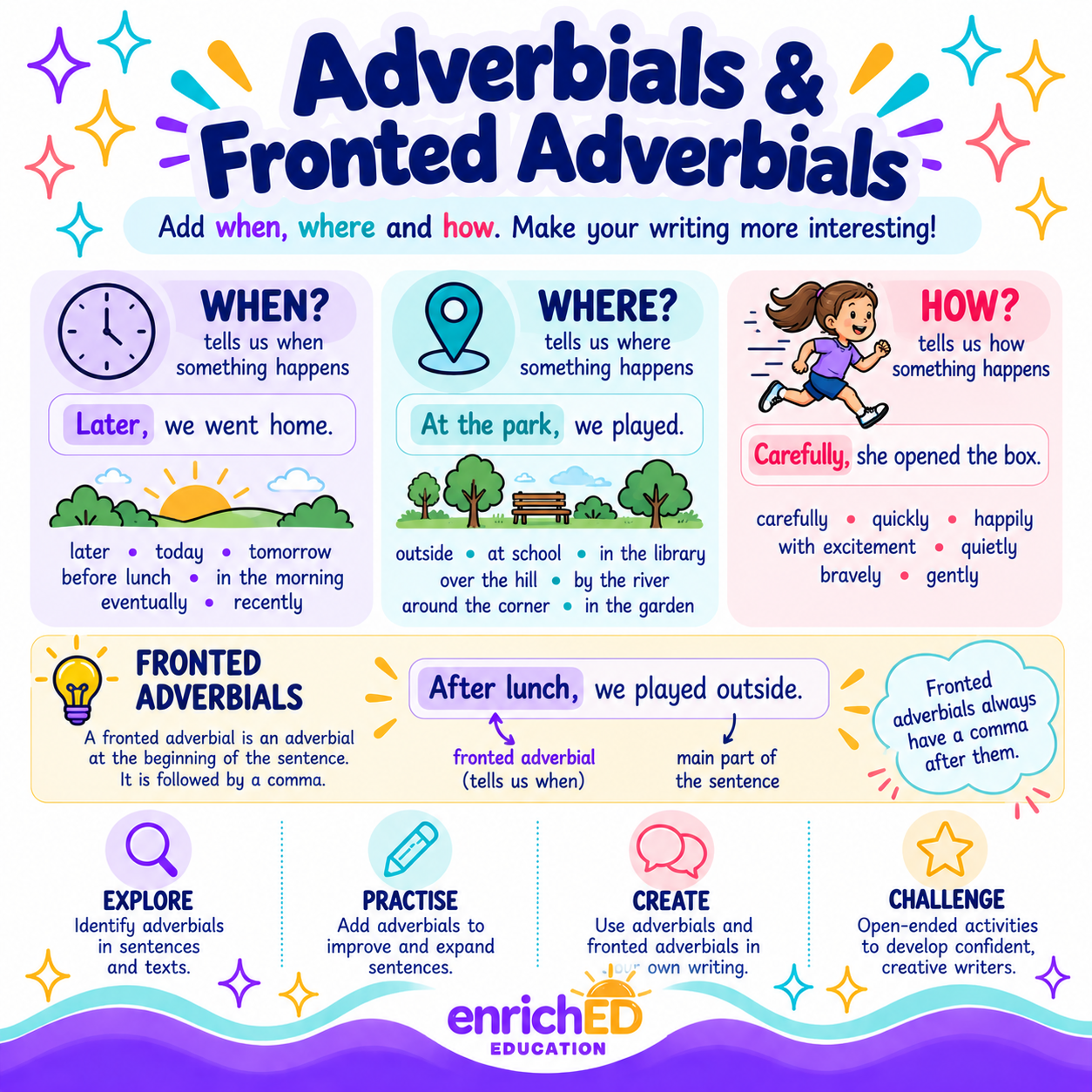
A practical grammar resource that helps students use adverbials and fronted adverbials to add detail and make their writing clearer and more interesting.
Students explore how adverbials tell us more about when, where and how something happens. They learn how to identify and use adverbials, move them to the beginning of sentences to create fronted adverbials, and correctly use a comma after a fronted adverbial.
Students will:
identify adverbials in sentences
recognise adverbials of time, place and manner
understand what information an adverbial adds
create fronted adverbials
use commas correctly after fronted adverbials
expand and improve sentences using purposeful adverbials
What's included:
Learning Intention and Success Criteria
Adverbials & Fronted Adverbials anchor chart
6 open-ended activities
Add the Adverbials worksheet
Adverbials in Action worksheet
sentence-expansion activities
identification and classification practice
independent writing challenge
5-page printable PDF digital download.